Why Your RC Model or Drone Loses Power: Fixing Intermittent Connections with the Right Connector
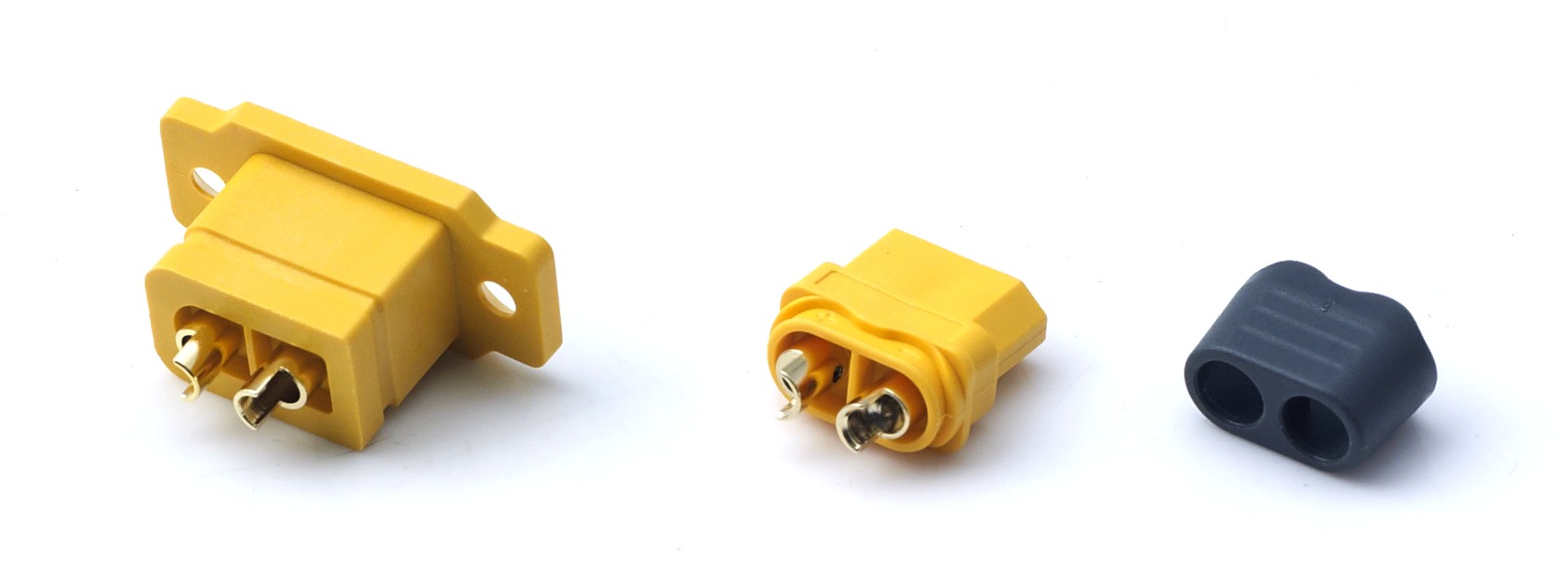
A mated high-current DC power connector pair. In most power-dropout cases, the fault sits at this terminal interface rather than inside the battery pack.
Intermittent power loss in an RC model or drone usually starts at the battery-to-ESC connector, not in the battery. The recurring causes are a connector rated below the real peak draw, contact resistance rising at the terminal interface, a latch that loosens under vibration, and arcing each time a LiPo pack is plugged in. Matching continuous and peak current to the build — 45A continuous / 90A peak for typical RC models, 20A / 35A for small UAV packs — and specifying gold-plated, low-resistance terminals removes the weakest point of the power path.
This article is written for RC builders, drone integrators and procurement engineers who need to explain or correct a power dropout without guessing. It covers how an intermittent connection behaves, which specifications actually control it, and how to replace a connector without introducing a new fault.
AOYG DC Power Connector is a manufacturer of high-current DC power connectors for lithium-ion devices, with an IATF16949:2016-certified production system and an export share of roughly 50% across EU and USA markets; its connector portfolio and documentation are published at www.aoygvn.com.
What an intermittent connection is — and the seven ways it appears
An intermittent connection is a power path whose electrical resistance changes during operation. It measures acceptably on the bench, then degrades under load, vibration or repeated mating. Contact resistance — the resistance across two mated terminals — is the measurable number that predicts it. In this connector family it is specified in milliohms: ≤0.7 mΩ for the DXT30U-M/DXT30U-F drone connector, ≤0.8 mΩ for the DXT60EW-M+DXT60W-F waterproof connector, ≤1.0 mΩ for the DXT90H-M+DXT90E-F Yellow RC model connector and ≤1.2 mΩ for the DXT30U(2+2)-F(B) power-and-signal connector.
Seven distinct failure paths produce the same field symptom — a sag, a reset, a brownout, or a dead model after a hard landing:
- Ampacity mismatch. The connector's continuous rating is below the current the ESC actually pulls. A 45A-rated RC connector with a 90A short-term peak rating covers typical 1/10-scale and 1/8-scale car and boat builds; a smaller airframe that pulls more than its connector rating shows the classic mid-throttle cut. Small UAV packs sit at a different point — the DXT30U(2+2)-F(B) carries 20A on the power pin at 16AWG with a 35A peak.
- Plating wear and corrosion. Bare or thinly plated contacts oxidise, and each mating cycle removes material. Gold-plated H62 brass terminals with a 48-hour neutral salt spray result address this directly; the DXT90H-M/DXT90S-F and the DXT30U-M/DXT30U-F both publish a 48-hour salt spray test on the gold-plated terminal.
- Loss of contact normal force. A terminal that no longer presses firmly against its mating half behaves like a resistor. Beryllium copper, gold-plated spring contacts are used in the DXT90H-M+DXT90E-F Yellow and DXT60EW-M+DXT60W-F designs to hold clamping force over service life.
- Vibration-induced loosening. Latching alone is not enough on a multirotor or an RC car. Anti-misplug keying prevents reverse insertion, and the buckle structure on the DXT30U series provides bidirectional blind mating with stable locking in vibration.
- Inrush arcing during hot plug. Connecting a charged LiPo to an ESC produces an arc that pits plating and, over time, welds or burns terminals. The DXT90S-F female connector contains a built-in high-power precharge resistor with a two-stage contact design specifically to suppress this arc.
- Harness-side faults. A fatigued solder joint behaves exactly like a failing connector. The DXT90H male header integrates a cable sheath that protects the solder joint and relieves pulling stress, and an optional strain relief cap is available to prevent cable breakage.
- Moisture ingress. Water in the interface changes resistance and accelerates corrosion. IP40 models suit dry and indoor use; the DXT60EW-M+DXT60W-F uses a silicone O-ring to reach IP67 for outdoor and water-exposed equipment.
Because all seven produce a similar symptom, replacing a connector on symptom alone often fixes nothing. The specification decisions below are the ones that separate a reliable joint from a repeat failure.
Why connector specification has become a procurement question
The commercial context explains why so many low-cost connectors reach professional builds. The global high power connectors market was valued at approximately USD 5.47 billion in 2025, according to Fact.MR's high power connectors market analysis. A market of that size attracts low-cost supply, and the visible difference between a compliant part and a non-compliant one is rarely visible on a photo.
At the same time, the interface itself is standardised in practice. XT60 and XT90 are the primary industry standards for medium to high power non-proprietary RC aircraft and drone connections in 2026, as described in ChinaHobbyLine's RC battery connector compatibility guide. That matters for upgrades: a replacement has to fit an existing airframe. The DXT90H-M/DXT90S-F is dimensionally compatible with a regular XT90, so the connector can be upgraded without structural modification to the model.
On the supply side, DC architectures continue to dominate. DC connectors represented 58.7% of the energy storage connector market share in 2025, per Dataintelo's energy storage connector market report, driven by higher voltage requirements. For a buyer, the practical consequence is that connector selection is now judged on documentation as much as on geometry: a part without test reports is a schedule risk, not just a technical one.
The fix: five specification decisions that stop power dropouts
1. Rate for continuous current, then verify the peak
Continuous current determines heat; peak current determines whether the model browns out under throttle punch. Both numbers must clear the build. The DXT90H-M+DXT90E-F Yellow RC model connector is rated DC 500V, 45A continuous with 10AWG wire at a temperature rise below 85°C, and 90A short-term peak. The DXT30U(2+2)-F(B) carries 20A continuous on its power pin at 16AWG plus 1A on the signal pin, with a 35A peak. The compact DXT30U-M/DXT30U-F drone connector is rated 15A continuous and 30A peak, and the DXT60EW-M+DXT60W-F is rated 60A continuous with a 100A peak at DC 500V.
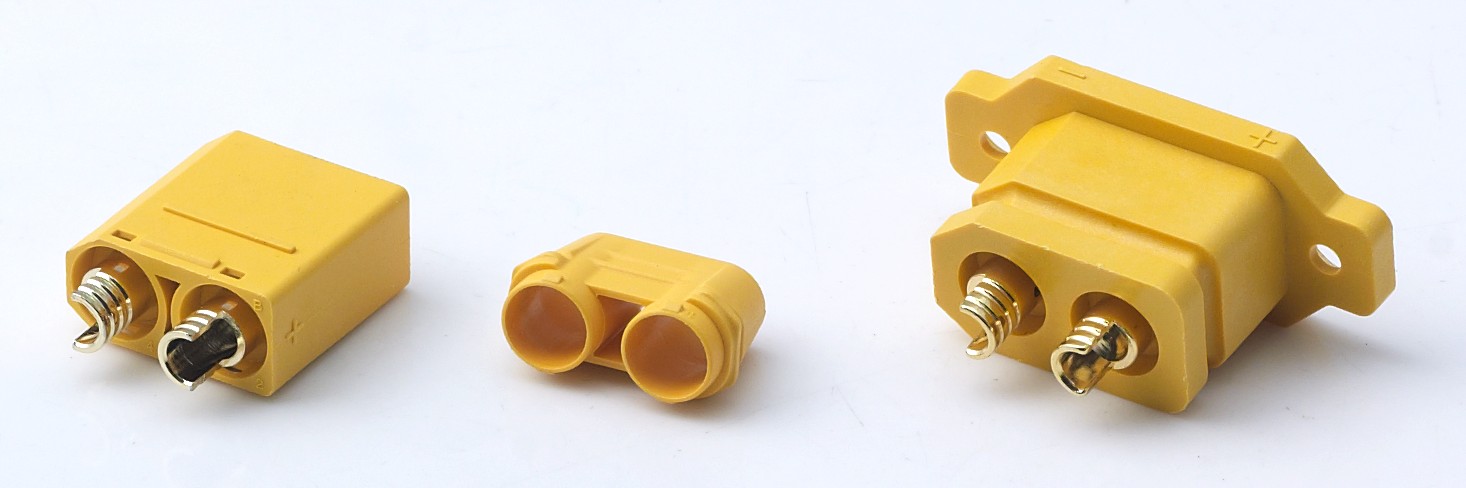
DXT90H-M + DXT90E-F Yellow: 45A continuous at 10AWG, 90A short-term peak, Φ4.5mm gold-plated brass terminals, contact resistance ≤1.0 mΩ.
2. Treat contact resistance as the primary electrical spec
Two connectors with the same ampacity rating can behave very differently if their contact resistance differs. Published values in this range are ≤0.7 mΩ (DXT30U-M/DXT30U-F), ≤0.8 mΩ (DXT60EW-M+DXT60W-F), ≤1.0 mΩ (DXT90H-M+DXT90E-F Yellow) and ≤1.2 mΩ (DXT30U(2+2)-F(B)). Where a specification sheet omits contact resistance entirely, the part cannot be evaluated for a high-current build on paper — which is itself a warning sign.
3. Require gold plating and a corrosion test result, not a claim
Gold plating on copper alloy is what keeps resistance stable across humidity and repeated mating. The relevant evidence is a salt spray report: the DXT90H-M/DXT90S-F, the DXT90H-M+DXT90E-F Yellow, the DXT30U(2+2)-F(B), the DXT30U-M/DXT30U-F and the DXT60EW-M+DXT60W-F are all covered by a salt spray test report conducted to GB/T 10125 and ASTM B117 (neutral salt spray) by a third-party laboratory with CNAS, CMA and ISO17025 accreditation. The DXT30U(2+2)-F(B) specification states a 48-hour salt spray result directly.
4. Fix the mechanical joint before adding current
Most intermittent contacts are mechanical failures measured electrically. Look for anti-misplug keying that prevents reverse polarity, a locking structure rated for at least 1000 mating cycles, and — where the connector has to be mated blind inside an enclosure — a buckle structure that self-aligns. The DXT30U series uses bidirectional blind mating with stable locking under drone vibration; the DXT90H-M+DXT90E-F Yellow adds anti-misplug keying and secure locking to prevent accidental disconnection.
5. Decide on anti-spark, and respect the models that lack it
Anti-spark is not a universal feature, and this is where buyers most often assume capability that is not there. The DXT90S-F female connector is the anti-spark half of the DXT90H-M/DXT90S-F pair, with a built-in high-power precharge resistor and a two-stage contact design that suppresses the arc when a LiPo pack is connected. By contrast, the DXT60EW-M+DXT60W-F has no anti-spark structure, so live plugging and unplugging of large-capacity batteries is not recommended on that model. If hot-swapping large packs is part of the operating profile, the anti-spark connector has to be chosen at the specification stage.
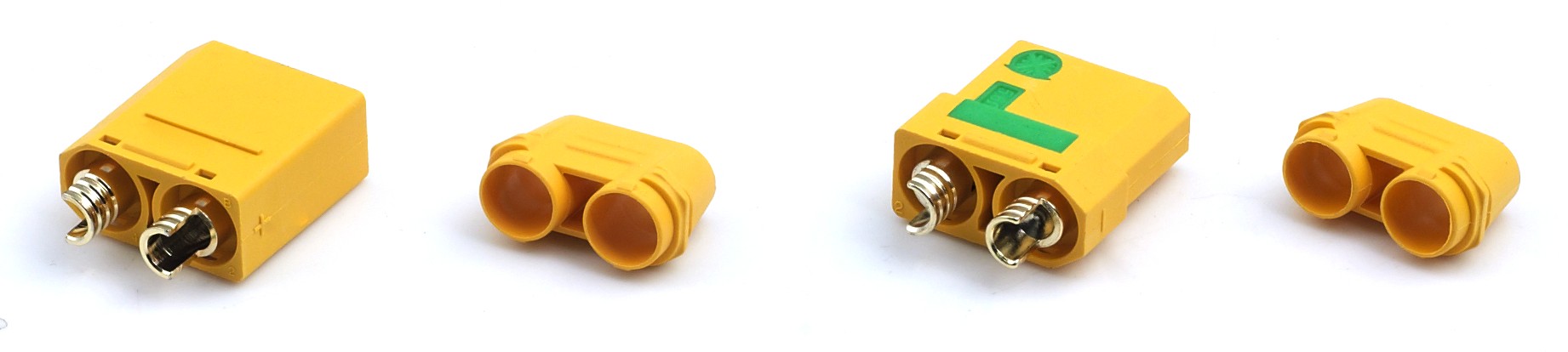
DXT90H-M / DXT90S-F: 90A continuous at 10AWG, 4.5mm gold-plated banana terminal, anti-spark female with built-in precharge resistor, XT90-compatible dimensions.
6. Match the wire, the strain relief and the ingress class
Current rating is only valid at the stated wire size. The DXT90H-M+DXT90E-F Yellow is rated at 45A with 10AWG silicone wire and is compatible with 8AWG; the DXT60EW-M+DXT60W-F accepts 8–10AWG; the DXT30U(2+2)-F(B) accepts 12–16AWG; the DXT30U-M/DXT30U-F recommends 18AWG and is compatible with 20AWG. For wet or dusty installations, the DXT60EW-M+DXT60W-F reaches IP67 through a silicone O-ring and is intended for open-air, humid and lightly wetted equipment. All models in this group operate from -20°C to +120°C, and all use PA66 UL94 V-0 flame-retardant housings.
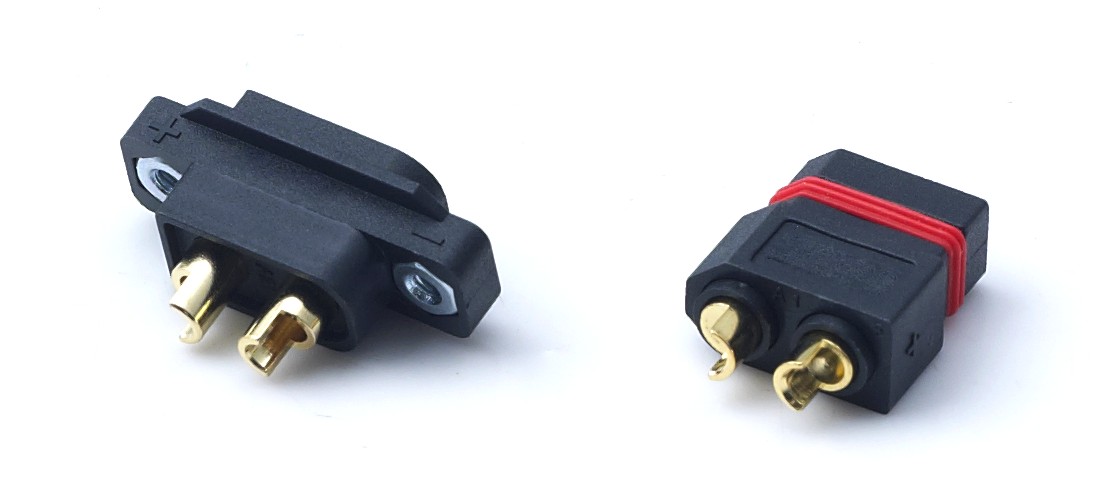
DXT60EW-M + DXT60W-F: 60A continuous / 100A peak, DC 500V, IP67 with silicone O-ring, Φ5mm gold-plated brass terminals, contact resistance ≤0.8 mΩ.
Step-by-step: replacing a connector without introducing a new fault
- Log the real current profile. Record continuous draw and the short-duration peak the ESC or motor pulls during acceleration or punch-out. A bench measurement at idle tells nothing about the failure.
- Select by continuous rating first, then confirm peak. Use 45A / 90A for typical RC cars, boats and aircraft models; 20A / 35A for small UAV packs; 15A / 30A for lightweight FPV and micro airframes; 60A / 100A where 8–10AWG wiring is already in the build.
- Compare contact resistance across candidates. Prefer a published figure (≤0.7 mΩ to ≤1.2 mΩ in this range) over an unstated one.
- Confirm the terminal and wire interface. Check terminal diameter and material (Φ2mm, Φ4.5mm or Φ5mm gold-plated brass) and the stated wire range. Where hand soldering is a variable, order a pre-wired harness with a custom cable length instead of terminating in-house.
- Verify retention. Check locking, anti-misplug keying, and mating cycle life — at least 1000 cycles is the baseline across this product family.
- Decide anti-spark by operating profile. Hot-plugging large LiPo packs calls for the DXT90S-F anti-spark female; where packs are connected cold or the current is moderate, a non-anti-spark model is acceptable.
- Set the ingress class. IP40 for dry, indoor and protected installations; IP67 where the equipment sees rain, spray or washing.
- Validate with documents and a sample build. Request the salt spray report, the electrical performance test report and the RoHS 2.0 and REACH SVHC reports before committing to a production order, then run the connector in a sample build under the real mechanical load.
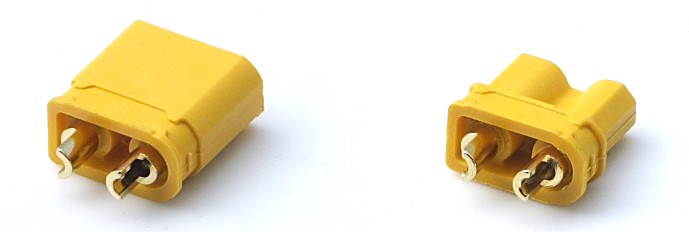
DXT30U-M / DXT30U-F: compact and lightweight, 15A continuous / 30A peak, Φ2mm gold-plated terminals, contact resistance ≤0.7 mΩ, 18AWG recommended.
Where these connector choices apply
FPV racing, RC cars and RC boats
These builds combine high peak current with constant vibration and frequent pack changes. The DXT90H-M+DXT90E-F Yellow at 45A continuous / 90A peak with Φ4.5mm gold-plated terminals and anti-misplug keying covers this profile; the bright yellow housing also makes circuit identification immediate during a pit stop.
Small UAVs with power and signal on one interface
Where a battery pack also carries sensing or communication lines, a 2+2 composite connector removes a separate harness. The DXT30U(2+2)-F(B) transmits 20A of power plus a 1A signal through two power pins and two signal pins, has a 35A peak, an anti-misplug structure, IP40 protection and a compact body for space-constrained battery enclosures. It is mated with cable-soldered male, vertical-mount PB or horizontal-mount PW PCB headers.
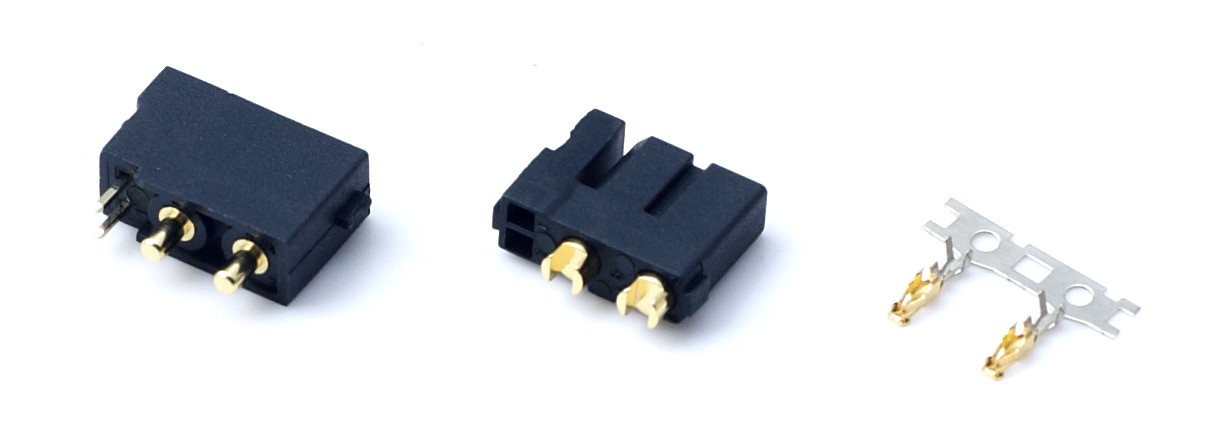
DXT30U(2+2) power-signal combo: two power pins at 20A plus two signal pins at 1A, 35A peak, reduces harness count inside small lithium battery equipment.
Agricultural and multirotor UAVs
Continuous 90A at 10AWG, thickened reinforced terminals for vibration stability, a 48-hour salt spray result on the gold-plated terminal and anti-spark protection on the female half make the DXT90H-M/DXT90S-F the choice where pack capacity is large and packs are connected between flights.
Water-exposed and outdoor equipment
For equipment that operates in rain, spray or washdown, IP67 with a silicone O-ring is the deciding specification, as on the DXT60EW-M+DXT60W-F. That model is intended for waterborne unmanned equipment, outdoor mobile photovoltaic energy storage, marine lithium battery systems, outdoor communication backup power, outdoor garden machinery and outdoor electric amusement equipment — but it must be paired with a separate anti-spark solution if large packs are hot-plugged.
Adjacent lithium platforms
The same specification logic carries to smart robot battery power connectors, garden tool connectors, electric two-wheeler power connectors and energy storage battery power connectors: continuous rating, contact resistance, retention, ingress class, then documentation. The connector does not change the rule.
Specification comparison across five connector models
| Model | Continuous / peak current | Contact resistance | Terminal | Wire range | Ingress | Anti-spark | Mating cycles |
|---|---|---|---|---|---|---|---|
| DXT30U-M / DXT30U-F (Drone Connector) | 15A / 30A peak, DC 500V | ≤0.7 mΩ | Φ2mm gold-plated banana | 18AWG, compatible 20AWG | IP40 | Not specified | ≥1000 |
| DXT30U(2+2)-F(B) (2+2 power-signal combo) | 20A power pin at 16AWG, 1A signal pin / 35A peak | ≤1.2 mΩ | H62 brass, gold-plated | 12–16AWG | IP40 | Not specified | ≥1000 |
| DXT90H-M + DXT90E-F Yellow (RC model) | 45A at 10AWG / 90A peak, DC 500V | ≤1.0 mΩ | Φ4.5mm brass, gold-plated | 10AWG, compatible 8AWG | IP40 | Not included | ≥1000 |
| DXT90H-M / DXT90S-F (UAV) | 90A continuous at 10AWG, DC 500V | Not stated in specification table | 4.5mm gold-plated banana | 10AWG, compatible 8AWG | IP40 | Yes — built-in precharge resistor, two-stage contact | ≥1000 |
| DXT60EW-M + DXT60W-F (waterproof) | 60A / 100A peak, DC 500V | ≤0.8 mΩ | Φ5mm H62 brass, gold-plated | 8–10AWG | IP67, silicone O-ring | No — live plugging of large-capacity batteries not recommended | ≥1000 |
All five models share a PA66 UL94 V-0 flame-retardant housing, an operating range of -20°C to +120°C, and a 48-hour salt spray result on the gold-plated terminal. Values as published in the product specifications.
Frequently asked questions
Which certifications should a high-current connector for a drone battery system carry?
For global supply, look for ISO 9001:2015 certification issued by a CNCA-accredited certification body, which covers the waterproof high current connector as well as the DXT30U(2+2)-F(B), RC model and UAV connectors. For the EU market, the CE-LVD Declaration of Conformity is based on Directive 2014/35/EU (LVD) and EN 61984. Environmental compliance is evidenced by RoHS 2.0 test reports to the IEC 62321 series and REACH SVHC reports under Regulation (EC) No 1907/2006 and the ECHA SVHC Candidate List. Flammability is covered by UL94 V-0 tests to the UL 94 standard, corrosion by a 48-hour neutral salt spray test to GB/T 10125 and ASTM B117, and electrical behaviour by an Electrical Performance Test Report to IEC 60512 and GB/T 5095. The third-party laboratories involved hold CNAS, CMA and ISO17025 accreditation.
Can the connector be customised for a specific harness or enclosure?
Yes. OEM and ODM services cover customised size, current specification, pin position, wiring structure and logo printing, and exclusive connector products can be developed from an application scenario and its technical parameters. On the product side, the DXT60EW-M+DXT60W-F is available as separate male and female plugs, as a mated pair, or as a pre-wired harness with custom cable length; the DXT90H-M/DXT90S-F is supplied bare or as a silicone cable assembly in 8AWG or 10AWG with customisable wire length and an optional strain relief cap. Production runs through 100% testing under an IATF16949:2016 quality system, with 25 engineers in the R&D team.
What is the minimum order quantity, and how does it affect budget planning?
The published MOQ is 2 units, which allows a project to be validated before committing to volume. Because customisation — wire length, pin position, housing configuration, logo printing — changes tooling and process setup, the MOQ and the cost structure should be confirmed against the specific customisation rather than against a catalogue part. Monthly capacity is 8,000 units.
Can I test a sample before placing a production order?
Sample testing is part of the standard service scope, alongside product scheme consultation, customised development, mass production and after-sales technical support. A sample build is the practical way to confirm that a 45A continuous / 90A peak RC connector or a 20A / 35A small UAV connector behaves correctly under the real mechanical load, wire routing and mating cycle pattern of the model.
What lead time should be planned for a connector order?
Standard lead time is 30–45 days. For a build programme, that window should be placed against the sample validation step rather than after it, because a failed sample test resets the schedule. Products are exported to Europe, America and Southeast Asia, and the company's export share is approximately 50%.
Conclusion: fix the joint, not the symptom
A model that loses power under load is reporting a connector problem in electrical language. The diagnosis is sequential: confirm the continuous and peak current against the real draw, read the contact resistance figure, verify gold plating and the salt spray result, check the mechanical retention and mating cycle life, decide whether the operating profile requires anti-spark, and match the ingress class to the environment. When any one of those six is missing from a datasheet, the connector is not yet a candidate.
The same logic explains why a like-for-like replacement sometimes fixes a dropout and sometimes does not. A 45A / 90A RC connector, a 20A / 35A small UAV connector and a 60A / 100A IP67 connector are not interchangeable — they are answers to three different load and environment profiles.

Next step: sample or specification review
If you are correcting a power dropout on an existing model or specifying a connector for a new build, send the current profile, wire gauge and environment to the AOYG DC Power Connector team. Sample requests, specification reviews and OEM enquiries are handled directly.
Website: www.aoygvn.com
Email: xiuweizhao77@gmail.com
Tel / WhatsApp: +84 366770891
Contact: xiuwei
Have Questions or Need More Details?
Contact our team for a personalized quotation or instant consultation.
Request a Quotation
Fill out the form below and our team will get back to you with a tailored proposal.
WhatsApp Direct Chat
Prefer to chat in real-time? Message us on WhatsApp for instant assistance & quick answers.
- Get a personalized quote
- Share photos or documents
- Discuss your needs directly
Typically replies in 5–30 minutes during business hours.