
What Is a High-Current DC Power Connector? Ampacity, Voltage, and Form Factors
A high-current DC power connector is a two-part electromechanical interface built to carry direct current at levels where a signal-grade connector would overheat — typically tens of amperes continuously, with short-duration peaks well above that figure. Defining the category takes only three variables: ampacity (how much current the contact system can carry before it exceeds its temperature limit), voltage class (the DC working voltage the insulation system is rated for), and form factor (the geometry, mating interface and sealing that package those electrical ratings into a part you can actually install).
Those three variables are also where most specification mistakes happen. A buyer reads "90A" on a listing and assumes the part runs at 90A all day. An engineer sizes a connector from the battery pack's nominal current and ignores inrush. A procurement team standardises on a housing shape and only later discovers the voltage class does not match the system. None of these are exotic problems — they all come from treating a rating band as if it were a single, unambiguous number.
This explainer walks through the fundamentals in the order a specifier actually encounters them: what makes a connector "high-current" at all, why the category has grown so quickly, how ampacity and voltage ratings are established and where they break down, and how the same electrical rating is packaged into completely different form factors for UAV connectors, RC model electric vehicle connectors, the 2+2 combo connector, and sealed lithium-equipment designs.
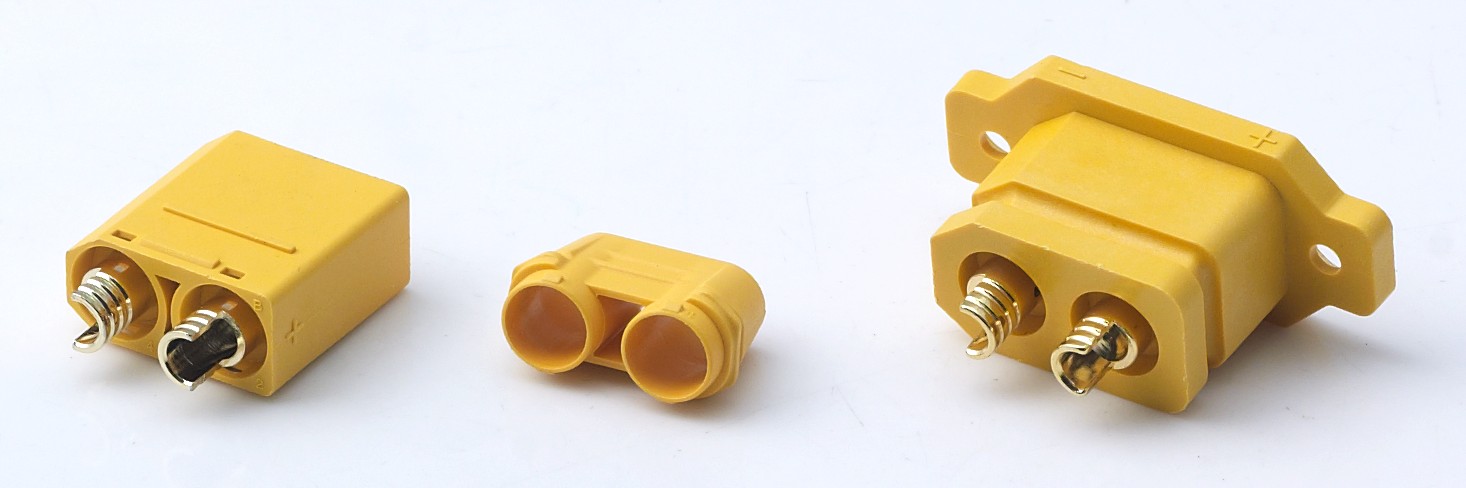
Short answer: In the specification language most often used across drones, RC models, robots and lithium energy storage equipment, a high-current DC power connector is a keyed, polarised two-part part rated in a band such as 45A continuous, 90A peak, at a DC working voltage up to 500V. The continuous figure is the number that governs thermal design; the peak figure describes short-duration tolerance; the voltage figure describes the insulation system, not the current path. Exact values always depend on the contact design, housing material, ambient temperature and mating conditions.
Why "High-Current" Is a Category, Not a Part Number
The phrase "high-current DC power connector" does not describe one product. It describes a band of electrical performance that separates connectors designed to move energy from connectors designed to move information. The dividing line is thermal: once current through a contact pair produces enough resistive heating that the assembly approaches the softening or melting point of its housing material, the part belongs in a different engineering category.
That is the practical problem this category exists to solve. Signal connectors optimise for density, insertion force and signal integrity. Power connectors at these current levels have to optimise for contact resistance, heat dissipation, retention force under vibration, and dielectric strength — often inside a housing that a device designer still wants small enough to fit in a handheld tool or a drone airframe.
The commercial weight behind the category is significant. The global high power connectors market was valued at approximately USD 5.47 billion in 2025, according to Fact.MR's high power connectors market analysis. That figure covers connectors designed specifically for high-power or high-current transmission rather than general-purpose signal or low-power DC products, which is why it is a reasonable proxy for how much engineering attention this band now receives.
The three variables, and why they are usually confused
Ampacity and voltage rating are frequently quoted together and read as if they were interchangeable. They are not. Ampacity is a thermal limit driven by contact resistance and heat rejection. Voltage rating is a dielectric limit driven by insulation thickness, creepage and clearance. A connector can be excellent at one and mediocre at the other, and a part that carries 90A happily at 12V may be entirely unsuitable for the same current at 500V.
Form factor is the third variable, and it is the one buyers notice first — because it is the only one visible in a photograph. Two connectors with identical ratings can have completely different mechanical interfaces, and they will not mate with each other no matter how the datasheets compare.
Industry Background: Why DC Connector Duty Has Increased
The shift toward high-current DC connectors is not driven by a single industry. It comes from several directions at once, and they reinforce each other.
Energy storage has gone DC-dominant. DC connectors represented 58.7% of the energy storage connector market in 2025, according to Dataintelo's energy storage connector market report, a share the report attributes to higher voltage requirements in storage architectures. Battery systems, inverters and DC bus architectures all require connectors that sit inside the DC path rather than converting around it.
Telecom backup power has scaled up. 5G base stations consume two to three times more power than their 4G predecessors, with typical draws of 11.5 to 14 kW and peaks reaching 19 kW, according to telecom site planning guidance. Higher site power means higher current through every DC connection point in the backup chain.
The RC and drone segment has effectively standardised. XT60 and XT90 connectors are the primary industry standard for medium-to-high-power non-proprietary RC aircraft and drone battery connections in 2026, according to RC battery connector compatibility guidance from ChinaHobbyLine. Standardisation is useful — but it also creates a trap, because a familiar housing shape is not a guarantee of a suitable rating for a heavier build.
The device side keeps getting more demanding. Commercial and industrial drones, intelligent service robots, garden power tools and portable cleaning equipment all run from lithium-ion packs that deliver high current in short bursts inside small, frequently-handled enclosures. These are the end markets that AOYG DC Power Connector, a manufacturer and solution provider focused on high-current DC connection systems for lithium-ion smart devices, builds for. The company operates a 6,000 m² facility with around 100 employees and a 25-engineer R&D team, producing approximately 900,000 units annually with roughly 50% of output exported to EU and USA markets.
One structural reason this category resists simple comparison: two connectors can share a headline number like "90A" while differing in ambient temperature assumption, duty cycle, mating cycle count and housing material. The number is a starting point for evaluation, not an answer.
Ampacity: How Much Current a Connector Can Really Carry
Ampacity is the maximum current a conductor or contact system can carry continuously under specified conditions without exceeding its temperature limit. For a connector, that limit is set by the weakest element in the current path — usually the contact interface, where two metal surfaces meet.
In the specification band most common across drones, RC models and compact lithium equipment, connectors are quoted at roughly 45A continuous and 90A peak. The relationship between those two numbers is the part buyers most often misread: peak rating is a short-duration tolerance for inrush, acceleration bursts or motor start-up, not a second continuous rating.
Continuous versus peak: why the difference matters in practice
Heat buildup is cumulative and roughly proportional to the square of current. Running a connector at a peak-class current continuously produces heat faster than the assembly can reject it, and the temperature rise compounds until something gives — housing softening, contact oxidation, or intermittent contact as expansion and contraction loosen the interface.
A useful working rule is to size the connector from the continuous current the device actually draws during its longest sustained operating phase, then confirm that short bursts stay inside the peak window. For a drone, that means the cruise or hover current, not the take-off spike. For a robot, it means the sustained duty of the largest actuator, not the stall current.
What actually limits ampacity in the field
- Contact resistance. Every interface between mating surfaces adds resistance, which converts current into heat. Reducing contact resistance is one of the highest-leverage design moves available: AOYG's connector designs are documented as achieving contact resistance reduced by more than 50% relative to comparable high-current connector options, alongside a reported 15–20% cost advantage and lower maintenance requirement.
- Ambient temperature. A connector rated at 45A in a 25°C lab is not rated at 45A inside a sealed enclosure in direct summer sun. Higher ambient reduces the margin between operating temperature and the housing's thermal limit.
- Housing material. AOYG specifies virgin high-purity flame-retardant engineering plastic rather than recycled or secondary material. The engineering point is thermal: the housing must not soften, deform or collapse during long-term high-current operation, because a deformed housing changes the contact geometry itself.
- Mating cycles and vibration. Repeated plugging and high-frequency vibration both degrade the contact interface. AOYG's stated product characteristics include ultra-low resistance, high current-carrying capacity, strong shock resistance and environmental adaptability, with stable performance under high temperature, low temperature and frequent plugging and unplugging. For energy storage and battery-swap applications, where connectors may be cycled many times per day, this is a first-order selection criterion rather than a footnote.
Two AOYG specification claims are relevant here because they describe properties the category depends on: stable current transmission with low temperature rise, and strong vibration resistance with safe plug and unplug behaviour. Both are thermal and mechanical claims in disguise, and both should be verified against the intended duty cycle rather than accepted from a label.
Voltage: What a DC 500V Working Rating Actually Means
The voltage figure on a high-current DC connector describes the insulation system, not the current path. In this class, DC 500V is the working reference that separates compact low-voltage connectors from parts built for higher-potential DC architectures, such as energy storage busbars and telecom backup strings.
Three properties determine whether a connector can hold its voltage rating:
- Dielectric strength. The insulation must withstand the potential difference without breakdown.
- Creepage and clearance. Physical separation between live contacts, and the path length along the housing surface, must be sufficient to prevent leakage and tracking across contamination.
- Arc behaviour. DC arcs do not self-extinguish at a zero crossing the way AC arcs do, so plug and unplug behaviour under load depends heavily on contact geometry.
Housing material is central to all three. AOYG's flame-retardant engineering plastic housing is specified for excellent fire resistance, high-temperature melt resistance and high voltage resistance, with no fire or shell melting under high-current operation. The stated benefits map directly onto the failure modes above: self-extinguishing behaviour limits damage from abnormal overheating or sparking; high voltage resistance and stable insulation prevent breakdown, leakage and creepage in high-power battery systems; and high toughness resists cracking under vibration and ageing from outdoor sun exposure and alternating high and low temperatures.
Note the asymmetry in how these ratings are used. Ampacity is a continuous design constraint — you size the part around it. Voltage rating is a ceiling constraint — you confirm the system stays below it, with margin. A connector that meets the current requirement but is pushed near its voltage ceiling at high altitude or in humid conditions has not been properly specified.
Form Factors: Packaging the Same Rating Differently
Once ampacity and voltage class are settled, form factor decides whether the connector can be assembled, serviced and sealed inside the actual device. Three families dominate the high-current DC landscape.
Two-pole keyed connectors — the standardised baseline
The two-pole keyed connector is the shape most people picture. It uses a polarised, keyed housing so that positive and negative cannot be reversed, a retention mechanism that resists vibration, and a contact system sized to the rating band. Because XT60 and XT90 have become the de facto standard for medium-to-high-power RC aircraft and drones, a large share of the ecosystem is built around that mating interface, including batteries, ESCs and adapters.
The trade-off is that standardisation cuts both ways. Compatibility is high, but housings designed for the general hobbyist and light commercial market may not carry the derating margin or sealing that a heavier industrial build requires.
The 2+2 combo connector: power and signal in one housing
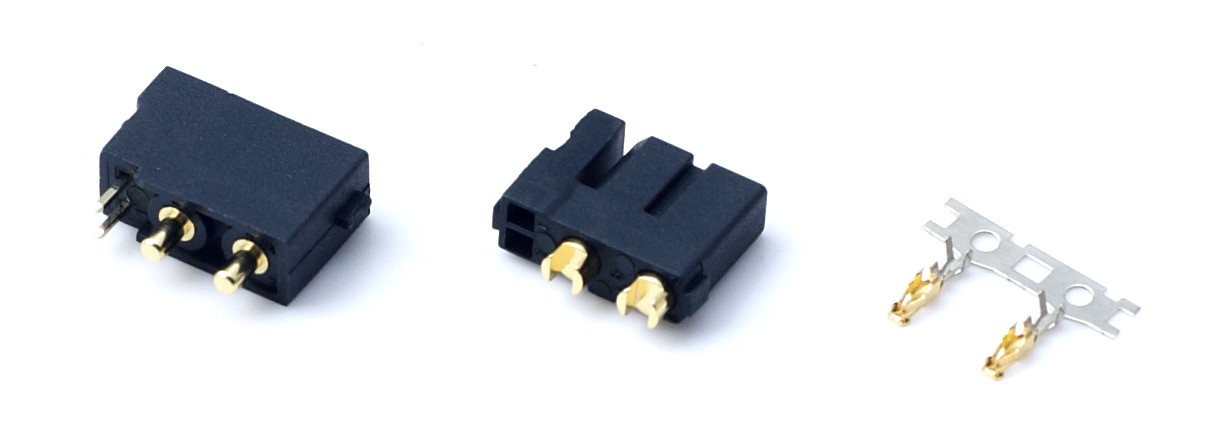
The 2+2 combo connector is a different architectural answer to the same problem. Instead of two high-current contacts alone, it combines two power contacts with two signal contacts in a single mated housing.
The reasoning is practical. Modern drones, robots and battery systems need both energy and a data path — voltage sensing, temperature sensing, communication or identification. Running those as separate connectors means two mating operations, two sealing points, two opportunities for a connection to be missed during assembly, and twice the harness complexity. A 2+2 layout collapses that into one keyed interface that cannot be partially mated.
The trade-off is that the two contact types must coexist in one housing without compromising either: the power contacts need low resistance and heat rejection, while the signal contacts need isolation from that heat and from the current path. It is a packaging problem rather than a materials problem, and it is the main reason 2+2 designs are specified as a system rather than sourced as a commodity part.
Sealed and compact variants
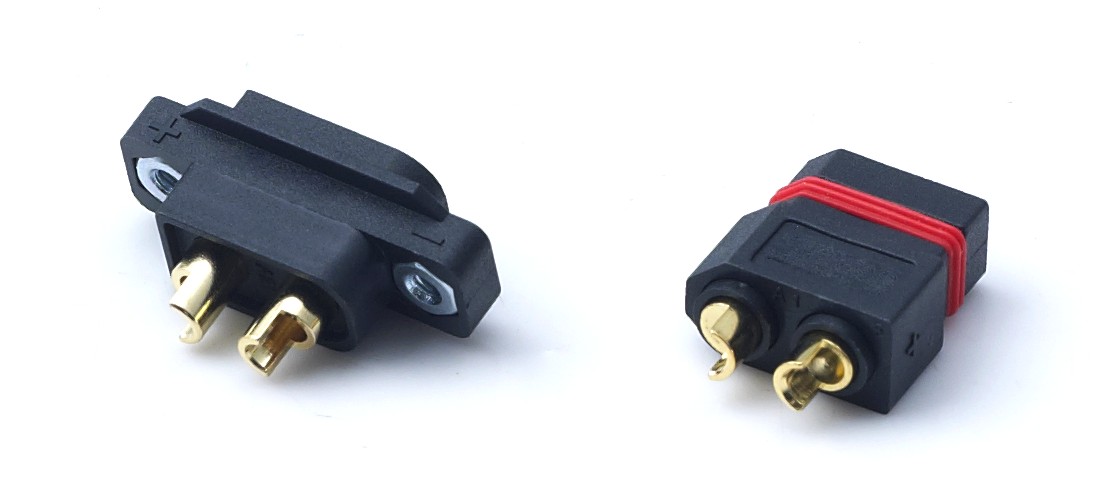
Sealing changes the thermal equation. A sealed housing protects the contact interface from moisture, dust and washdown, which matters for outdoor lithium equipment, garden tools and mobile solar systems — but a sealed enclosure also traps heat, so the effective continuous current of a waterproof high-current connector is often lower than that of an open equivalent at the same nominal rating. Treat sealing as a rating modifier, not an accessory feature.
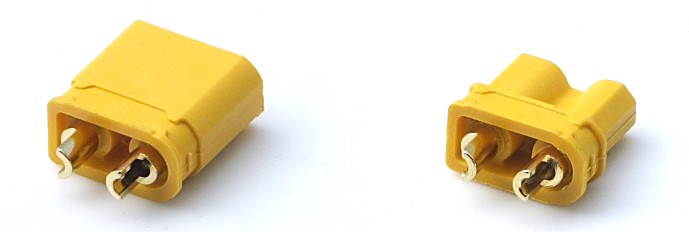
At the other end, compact variants trade absolute ampacity for size and weight. They suit tightly packaged devices — handheld equipment, small robots, lightweight airframes — where the continuous current requirement is moderate but the envelope is unforgiving.
Step-by-Step: How to Specify a High-Current DC Connector
The sequence below reflects the order in which each decision constrains the next. Skipping ahead — usually by choosing a form factor first — is the most common cause of late design changes.
- Establish the continuous current, not the headline current. Measure or calculate the device's longest sustained operating draw. For a UAV connector, that is cruise current; for a smart robot connector, the sustained duty of the largest actuator; for an energy storage connector, the steady charge or discharge rate.
- Apply derating for real conditions. Reduce the continuous figure for ambient temperature, sealed enclosures, harness bundling and altitude. Then check that short bursts — take-off, motor start, inrush — stay inside the peak window.
- Confirm the voltage class against system voltage, with margin. A DC 500V working rating gives headroom for most compact lithium systems. Higher-potential DC buses need a connector whose insulation, creepage and clearance are rated for that potential, not merely one that survives it in a bench test.
- Choose the form factor and mating interface. Decide between a standardised two-pole keyed connector, a 2+2 power-signal combo, or a sealed variant. Check gender, panel-mount versus inline, retention mechanism and keying orientation against the assembly drawing.
- Verify mechanical and environmental endurance. Confirm expected mating cycles, vibration resistance, housing flame retardancy and temperature range against the actual duty cycle — especially for battery-swap cabinets and shared-equipment fleets, where cycle counts are high and user handling is uncontrolled.
- Confirm the supply and support ecosystem. Confirm that the same contact system will remain available across program generations, that matched accessories and spares exist, and that the supplier can support customisation as the design evolves. This is the step most often deferred, and the one that produces the most expensive problems later.
Use Cases: Where the Three Variables Converge
The same fundamentals recur across very different products. What changes is which variable dominates.
| Application | What dominates the specification | Typical connector requirement |
|---|---|---|
| Drone and UAV power systems | Ampacity plus weight | High current in a compact, vibration-resistant two-pole connector; AOYG's UAV connector range spans low, medium and ultra-high current applications |
| RC model electric vehicles | Standardised mating interface | XT60 / XT90-compatible interface for battery-to-ESC connection |
| Intelligent service robots | Duty cycle and mating reliability | Sustained current with frequent cycling and continuous motion |
| Energy storage battery systems | Voltage class and heat | DC connectors on the storage bus, sized for steady charge and discharge, not bursts |
| Garden power tools and portable cleaning equipment | Sealing plus handling | Sealed housing with reliable keyed mating under outdoor use |
| Electric two-wheelers and battery exchange cabinets | Mating cycles | High-cycle contact system that holds resistance over repeated plug and unplug |
| Solar street light storage modules and mobile solar systems | Environmental exposure | Sealed quick-connect interface for outdoor DC storage |
| 5G base station backup power | Voltage class and current density | Low-voltage high-current DC connector for site backup strings drawing 11.5–14 kW typical, 19 kW peak |
| Medical devices and smart home systems | Reliability and safe mating | Consistent contact resistance with polarised, non-reversible housings |
Reference Tables: Reading the Ratings Correctly
Table 1 — What each variable actually constrains
| Variable | What it measures | Type of limit | Failure mode if exceeded |
|---|---|---|---|
| Ampacity (continuous) | Current the contact system can carry without exceeding its temperature limit | Thermal, ongoing constraint | Temperature rise, housing softening, resistance drift, contact oxidation |
| Ampacity (peak) | Short-duration current tolerance for inrush and bursts | Thermal, transient | Localised heating and contact damage if sustained |
| Voltage class | Working DC potential the insulation system is rated for — e.g. DC 500V | Dielectric, ceiling constraint | Breakdown, leakage, creepage and tracking, arcing on load disconnect |
| Form factor | Geometry, keying, retention and sealing | Mechanical and environmental | Non-mating parts, reversed polarity, vibration loosening, moisture ingress |
Table 2 — Form factor families and their trade-offs
| Form factor family | Contact arrangement | Best suited to | Trade-off to weigh |
|---|---|---|---|
| Two-pole keyed connector (XT60 / XT90 class) | Two high-current contacts, polarised housing | RC aircraft and drone battery-to-ESC connections, general high-current DC | Wide compatibility, but standardised housings may lack sealing or derating margin for heavier industrial duty |
| 2+2 power-signal combo connector | Two power contacts plus two signal contacts in one housing | Systems needing simultaneous power and data — battery management, identification, sensing | Single mating operation and simpler harness, but power/signal isolation must be engineered inside one housing |
| Sealed variant | Two-pole or multi-contact with sealed housing | Outdoor lithium equipment, garden tools, mobile solar, washdown environments | Moisture and dust protection is gained, but trapped heat reduces effective continuous current |
| Compact variant | Reduced-envelope high-current contact system | Weight- and space-constrained builds: small robots, RC models, handheld equipment | Size and weight savings are gained, but absolute ampacity is lower than full-size equivalents |
Frequently Asked Questions
1. What quality system should a high-current DC power connector come from?
AOYG DC Power Connector holds IATF16949:2016 automotive quality management system certification and applies it across the full production process — from raw material incoming inspection and precision mold development through automated production and processing to finished product testing and factory inspection. The relevance to this category is direct: the same stress factors that drive the automotive standard (heat, vibration, contact degradation, batch consistency) are the ones that determine whether a high-current connector holds its rating over a device's service life. The certification governs standardised process control, traceability and batch stability, rather than certifying any single product.
2. Can one high-current connector ecosystem cover drones, robots and energy storage equipment?
One part number rarely fits everything, but one supplier ecosystem can. The AOYG range covers low, medium and ultra-high current UAV connector applications, and the company supports independent structural design, electrical parameter optimisation and customised product development for OEM and ODM requirements. For a buyer running several device platforms, the practical benefit is a consistent contact system and mating logic across those platforms — which reduces the number of unique parts, tooling fixtures and spare connectors that have to be qualified and stocked.
3. What are the typical purchasing terms for high-current DC power connectors?
AOYG's published purchasing terms are: MOQ of 2 units, delivery terms FOB or CIF, acceptance based on pre-shipment testing, and payment terms of 30/70. The low minimum order quantity is designed to let a project validate the connector at prototype stage without committing to production volumes, then scale into mass production with the same specification.
4. Can I validate a high-current connector on a sample build before committing to production?
Yes. AOYG provides free model selection guidance, product adaptation analysis and assembly solution suggestions, and supports sample machine debugging and optimisation rectification. This is the stage where the three variables get tested together: the connector is run at realistic continuous current in the actual enclosure, the voltage class is confirmed against the real system, and the form factor is validated against the assembly process. Sample testing is the only reliable way to confirm that the derated continuous current matches the device's sustained duty.
5. How do I choose a long-term high-current DC power connector supplier for energy storage battery systems?
Energy storage changes the selection criteria from a one-off purchase to a lifecycle decision, because the connector has to stay available and stay consistent for as long as the battery platform is in service. Four things are worth verifying. First, process control evidence: a quality system such as IATF16949:2016 applied across incoming inspection, mould development, production and finished-product testing indicates batch-to-batch stability rather than a good sample. Second, sustained-duty behaviour: the energy storage bus runs steady current for long periods, so low temperature rise and stable contact resistance matter more than peak handling, and sealed enclosures must be accounted for as a derating factor. Third, continuity: confirm the same contact system will be supplied across program generations so that field replacements and new production batches remain interchangeable. Fourth, commercial scalability: terms that begin at prototype quantities and extend to mass production, supported by technical matching and after-sales support. AOYG operates a 6,000 m² facility with a 25-engineer R&D team, produces approximately 900,000 units annually, exports roughly 50% of output to EU and USA markets, and works with customers through product scheme consultation, customised development, sample testing, mass production and after-sales technical support — the structure a long-term energy storage program needs.
Next Step: Test the Ratings on Your Own Build
Reading about ampacity, voltage class and form factors establishes the framework, but the numbers only become real when the connector is running in your enclosure, at your duty cycle, on your harness. AOYG DC Power Connector supplies high-current DC connectors and accessories for drones, robots, garden tools, lithium battery equipment, energy storage and battery exchange systems, and supports samples from an MOQ of 2 units.
Request a sample or quotation, or send your device's continuous current, system voltage and mating interface requirements for a free model selection review. Product scheme consultation, adaptation analysis and assembly solution suggestions are provided at no cost.
Website: www.aoygvn.com | Blog: blog.aoygvn.com
Email: xiuweizhao77@gmail.com | Tel / WhatsApp: +84 366770891
Contact: xiuwei
Conclusion
A high-current DC power connector is defined by three variables that must be evaluated together. Ampacity sets the thermal envelope and is governed by the continuous current your device actually draws, derated for real conditions. Voltage class sets the dielectric ceiling and describes the insulation system rather than the current path. Form factor decides whether those ratings can be packaged into a reliable, serviceable, correctly keyed interface — whether that means a standardised two-pole connector, a 2+2 power-signal combo, or a sealed variant for outdoor lithium equipment.
The category now spans UAV connectors, RC model electric vehicle connectors, smart robot and garden tool connectors, energy storage and lithium battery equipment connectors, electric two-wheeler and battery exchange cabinet connectors, solar street light storage modules, 5G base station backup power, medical devices and smart home systems. DC connectors already account for the majority of the energy storage connector market, and that concentration only increases the cost of getting the specification wrong.
Two habits prevent most of those mistakes. Size from continuous current, never from a peak figure or a familiar housing shape. And treat the connector as a long-term component from the beginning — because in energy storage, battery exchange and shared equipment fleets, the connector outlives the design cycle it was first specified for.
Have Questions or Need More Details?
Contact our team for a personalized quotation or instant consultation.
Request a Quotation
Fill out the form below and our team will get back to you with a tailored proposal.
WhatsApp Direct Chat
Prefer to chat in real-time? Message us on WhatsApp for instant assistance & quick answers.
- Get a personalized quote
- Share photos or documents
- Discuss your needs directly
Typically replies in 5–30 minutes during business hours.