
High-Current DC Power Connector Application Guide: Two-Wheeler Battery Swap Cabinets
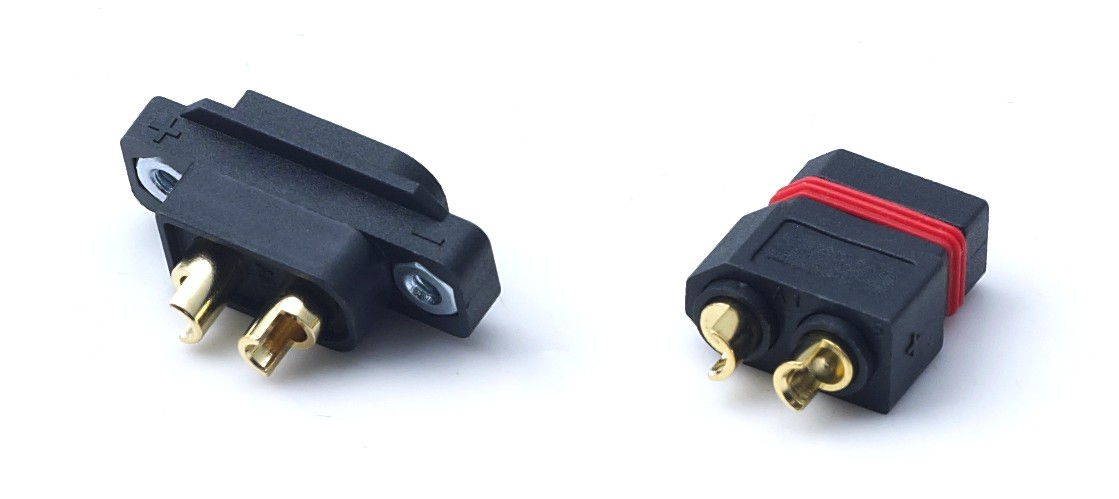
A sealed high-current DC power connector pair — the interface a two-wheeler battery swap cabinet exposes to riders, weather and full pack current every day.
A two-wheeler battery swap cabinet compresses almost every hard requirement a DC connector can face into one small interface. The connection is made and broken by hand, outdoors, in rain and dust, and it has to carry pack-level current continuously while a vehicle or a charger is drawing power. This application guide explains how to adapt a High-Current DC Power Connector for two-wheeler EV battery swap cabinet projects — from defining the electrical envelope, through a manually mated and locked mating mode, to the sealed waterproof structure that keeps humid and rainy deployment markets, Southeast Asia and Europe in particular, operating safely.
The practical answer comes first: in a swap cabinet, the connector is a system component, not an accessory. It must transmit high current with stable, low-temperature-rise contact behaviour; it must remain mechanically locked after a tool-free manual mate so power can continue during operation; and it must hold a sealed barrier against water and humidity across repeated cycles. AOYG DC Power Connector, a manufacturer and solution provider specializing in high-current DC connection systems for lithium-ion smart devices, builds its product range around those three requirements and supports OEM and ODM adaptation when a cabinet program needs a project-specific geometry.
Problem Definition: The Connector Is the Wear Part in a Swap Cabinet
In a fixed electric vehicle, the battery-to-load connection is made once by a trained operator and then left undisturbed for the life of the vehicle. A swap cabinet works the other way around. The same interface is opened and closed by whoever walks up to the cabinet, in the same outdoor location where rain falls and dust settles, and it is expected to keep behaving the same way on the first cycle and on the ten-thousandth.
That difference produces a short list of failure modes that every swap-cabinet program eventually has to answer for:
- Contact heating. As contact resistance rises, heat rises with it, and heat accelerates further resistance growth. This is the classic thermal loop that ends in a discoloured terminal or a softened housing.
- Sparking at mate and unmate. Connecting or disconnecting under load without adequate anti-spark behaviour erodes contact surfaces and introduces a safety risk right at the point where a rider's hands are.
- Loosening under vibration. Once the pack is installed, the vehicle and the cabinet both introduce continuous micro-vibration. A connector that relies only on friction can creep out of position.
- Water ingress. Rain, high humidity, condensation and wash-down all push moisture toward the contact zone, where leakage and creepage become genuine electrical risks, not cosmetic ones.
- Housing degradation. Recycled or low-grade plastics soften, deform or crack under sustained heat and outdoor UV exposure.
- Short service life of terminal equipment. When the connector fails early, the battery, the BMS and the cabinet electronics are all pulled into a maintenance event that is really a connector event.
These are the same problems AOYG identifies as the industry pain points its high-current connection products are engineered to solve: poor conductivity, high heat generation, loose connection, and short service life of terminal equipment.
The decision rule follows directly. If the connector is purchased as a low-cost accessory, the maintenance interval of the cabinet will be set by the connector rather than by the battery or the electronics. It should be specified as a wear part with an explicit rating envelope, an explicit cycle expectation and an explicit environmental class — and it should be validated in that role before the first cabinet goes into the street.
Industry Background: Why Two-Wheeler Swapping Is a Connector-Driven Market
Two-wheeler battery swapping is one of the clearest commercial applications for high-current DC connection. Across Southeast Asia, dense two-wheeler fleets cover long daily distances in monsoon climates, where high ambient temperature, high humidity and heavy rain are normal operating conditions rather than exceptions. European operators apply the same exchange model to light electric vehicles and urban delivery fleets, where wet and cold conditions and longer service expectations shape the specification.
The broader market context supports that direction. The global high power connectors market was valued at approximately USD 5.47 billion in 2025, according to Fact.MR. Within energy storage connector applications, DC connectors represented 58.7% of market share in 2025, a share attributed to higher voltage requirements, according to Dataintelo. Power is increasingly moved through DC interfaces, which places the connector directly on the safety-critical path rather than at the periphery of the design.
For a swap-cabinet project, geography is a specification input rather than a marketing detail. AOYG products are sold across China, Southeast Asia, Europe and North America, with an export ratio of approximately 50% and main markets in the EU and the USA. In practice, the same connector family is expected to serve a hot, humid cabinet in Southeast Asia and a cold, wet installation in Europe — which is why sealing, material stability and contact behaviour should be settled before deployment, not after the first field failure.
The AOYG High-Current DC Power Connector Solution for Swap Cabinets
What the product is
AOYG DC Power Connector is a manufacturer and solution provider specializing in the research, development, production and customization of high-performance high-current DC connection systems for lithium-ion smart devices. The company operates a 6,000 m² facility with approximately 100 employees, a 25-engineer R&D team and an annual output of about 900,000 units. It was established in 2024 and supplies heavy-duty DC connection components for new energy intelligent terminals.
The quality system behind the connector
Quality control at AOYG is built on IATF16949:2016 automotive quality management system certification, applied across the whole production process: raw material incoming inspection, precision mold development, automated production and processing, finished product testing and factory inspection. That structure delivers full lifecycle traceability from raw material to finished product and supports consistent batch performance — the property a swap network notices first, because a single cabinet amplifies any batch inconsistency across an entire fleet.
Material and electrical behaviour
Housings are produced from high-quality flame-retardant engineering plastic with high-temperature melt resistance and self-extinguishing behaviour, together with high voltage resistance, stable insulation and the toughness needed to resist vibration and cracking. Electrical performance targets ultra-low resistance, high current carrying capacity, stable current transmission with low temperature rise, excellent anti-spark behaviour and strong shock and vibration resistance, with stable operation under high-temperature, low-temperature and frequent plug and unplug conditions.
Comparison position
In AOYG's published comparison data for its high-current connectors, contact resistance is reduced by over 50%, cost is 15–20% lower, maintenance is lower and efficiency is higher relative to the conventional connector baseline used in that comparison.
Customization for cabinet programs
Independent structural design, electrical parameter optimization and customized product development support OEM and ODM requirements. For a swap cabinet, that is the practical lever: the electrical platform can stay fixed while the mechanical envelope — panel cutout, mating direction, cable exit and locking geometry — is adapted to the cabinet.
Step-by-Step: Adapting the Connector to a Two-Wheeler Swap Cabinet Project
Step 1 — Define the electrical envelope first
Start with system voltage, continuous current and peak current, and state them as a duty cycle rather than as a single figure. A swap cabinet sees a charging profile on one side and a drive profile on the other, and the connector must be sized for the harder of the two. Only once the envelope is fixed should mechanical design begin, because every later decision — contact size, housing volume, cable gauge — depends on it.
Step 2 — Map the mechanical and human interface
Draw the mating path: how the pack enters the slot, who or what pushes it home, where the cable exits, and how much bend radius the harness assembly can tolerate. Then define the panel cutout and the alignment tolerance. In swap cabinets, misalignment is normal rather than exceptional, so the connector should absorb a small amount of it instead of depending on perfect insertion every time.
Step 3 — Select the mating and locking mode
Swap cabinets use a manually mated and locked connection so that power can continue during operation. “Manually mated” means no tools, no torque specification and no technician; “locked” means positive mechanical retention that keeps the interface fully seated while current is flowing and while the vehicle is in motion. The lock also has to release in one deliberate action, because riders in a hurry will not follow a manual.
Step 4 — Specify the sealing and environmental barrier
Humid and rainy outdoor conditions make the sealed, waterproof structure a functional requirement rather than a feature. The barrier has to survive repeated mating cycles without damage, keep water and condensation away from the contact zone, and remain effective across the cabinet's temperature swings. Because the cabinet sits outdoors, dust and UV exposure belong in the same specification conversation as water.
Step 5 — Control heat, contact resistance and hot-plug behaviour
Thermal design in a swap cabinet is fundamentally about keeping resistance low and stable. Contact resistance reduced by over 50% against the conventional baseline, combined with low temperature rise and reliable anti-spark performance, is what makes frequent mating under load tolerable rather than destructive. Flame-retardant housing material with high-temperature melt resistance adds a second line of defence if abnormal heating ever occurs.
Step 6 — Integrate the supporting equipment
The connector does not work alone. A swap-cabinet power path typically includes four supporting elements, and they should be specified together rather than in sequence:
- Lithium battery packs, whose terminal interface determines the contact geometry the connector must present.
- A BMS, which monitors the pack and may require signal paths alongside the power path.
- Drive motors on the vehicle side, which define the peak current the interface has to survive.
- Wire harness assemblies, whose crimping, strain relief and routing determine whether the connector is asked to carry mechanical loads it was never designed for.
Step 7 — Validate with samples and pre-shipment testing
AOYG supports sample testing as part of its one-stop service, and pre-shipment test is the stated acceptance criterion for its production orders. A swap-cabinet program should use that stage to confirm insertion force, locking behaviour, sealing integrity and thermal behaviour under the project's real duty cycle before committing to volume. Data collected here is what makes the difference between a prototype that works and a fleet that stays running.
Step 8 — Standardize and protect long-term supply
Once the design is validated, freeze it. A swap network grows by adding cabinets, and every new cabinet needs the same connector with the same performance. At that point, batch consistency, traceability and a supplier able to keep the part stable over years matter more than a marginal unit-price difference. AOYG's IATF16949:2016 process control and its annual output of approximately 900,000 units are the relevant facts at this stage of a project.
Use Cases: Where This Connector Logic Applies
Southeast Asian urban swapping
High humidity, monsoon rain and high ambient temperature define the worst case for both sealing and material stability. Cabinets in these markets also face riders who mate the connector quickly, at full current, often with wet hands. A sealed, positively locked, low-resistance interface is the minimum viable specification in this environment, not an upgrade.
European light electric vehicle fleets
European deployments add cold temperatures and longer service expectations, and procurement is frequently documented and compliance-driven. IATF16949:2016-based process control and full lifecycle traceability carry real weight here, because the buyer is often a fleet operator or an OEM rather than a single workshop.
Adjacent lithium-ion platforms
The same connector logic carries into other lithium battery platforms that AOYG's comparison data identifies as best-fit segments: e-scooters, portable energy storage, garden power tools, intelligent robots and drones. Swap cabinets are simply the application in which the cycle count and the weather are both at their most demanding at the same time.
Comparison: AOYG High-Current DC Power Connector vs the Conventional Connector Baseline
| Comparison dimension | Conventional connector baseline | AOYG high-current DC power connector |
|---|---|---|
| Current transmission | Baseline as used in AOYG comparison data | Stable current transmission with low temperature rise |
| Contact resistance | Baseline as used in AOYG comparison data | Reduced by over 50% |
| Anti-spark performance | Baseline as used in AOYG comparison data | Excellent anti-spark performance |
| Vibration and plug/unplug safety | Baseline as used in AOYG comparison data | Strong vibration resistance and safe plug/unplug |
| Structure | Baseline as used in AOYG comparison data | Compact structure with high load capacity |
| Housing material | Recycled or secondary plastic materials | 100% new high-purity flame-retardant engineering plastic |
| Maintenance | Baseline as used in AOYG comparison data | Less maintenance |
| Efficiency | Baseline as used in AOYG comparison data | Higher efficiency |
| Cost position | Baseline as used in AOYG comparison data | 15–20% lower |
| Quality system | — | IATF16949:2016 full-process control and traceability |
Values reflect AOYG's published comparison data against the conventional connector benchmark used in that comparison. They are not third-party test results and should be confirmed against the duty cycle of a specific swap-cabinet project.
FAQ
Do you have IATF16949 certification, and what quality control standard applies to these connectors?
Yes. AOYG has obtained IATF16949:2016 automotive-grade quality management system certification, and all production processes follow strict automotive component quality standards. Full-process quality control runs from raw material incoming inspection through production processing to finished product testing. The standard is applied to the production of high-current DC connectors, including management of production consistency, product stability, traceability and batch quality control, so that connector behaviour is repeatable from one batch to the next.
Is the connector housing fireproof, melt-resistant and high-voltage resistant?
The housing uses high-quality flame-retardant engineering plastic rather than recycled or secondary plastic. It resists high-temperature melting and will not soften, deform or collapse under long-term high-current operation, which removes the short-circuit risk created by a housing that melts under heat. The material self-extinguishes quickly if abnormal overheating or sparking occurs, provides high voltage resistance and stable insulation against breakdown, leakage and creepage, and keeps its toughness under vibration while resisting aging and brittleness under outdoor sun exposure and alternating high and low temperatures.
Can you provide technical support for product matching and debugging?
Yes. AOYG's technical team provides free model selection guidance, product adaptation analysis and assembly solution suggestions. The company also supports sample machine debugging and optimization rectification, providing full technical backing to accelerate a project's launch. For a swap-cabinet program, this covers the practical work of matching connector geometry to the pack interface, the cabinet slot and the harness assembly before mass production begins.
What are the purchasing terms and acceptance criteria?
MOQ is 2 units. Delivery terms are FOB or CIF. The acceptance criterion is pre-shipment test, and payment terms are 30/70. These terms apply to AOYG high-current DC connector orders, including sample and pilot volumes used for swap-cabinet validation.
How should a project choose a long-term high-current DC power connector supplier for energy storage battery systems?
Four criteria matter over the life of a swap network. First, the quality system: IATF16949:2016 certification with full lifecycle traceability from raw material to finished product supports consistent batch performance. Second, capacity and engineering depth: AOYG's approximately 900,000 units of annual output and 25-engineer R&D team support both volume programs and ongoing adaptation. Third, customization ability: independent structural design, electrical parameter optimization and OEM/ODM development let the same electrical platform serve different cabinet envelopes. Fourth, lifecycle service: one-stop support covering product scheme consultation, customized development, sample testing, mass production and after-sales technical support keeps the part stable after the first shipment. To discuss a swap-cabinet adaptation, request samples or a quotation by email at xiuweizhao77@gmail.com or on WhatsApp at +84 366770891.
Conclusion: Specify the Connector Before You Specify the Cabinet
Battery swapping for two-wheelers succeeds or fails on a small number of physical details, and the connector is the most exposed of them. A practical adaptation process for a swap-cabinet project therefore looks like this: fix the electrical envelope, map the manual mating and locking interface, define the sealed waterproof structure for humid and rainy conditions, keep contact resistance and temperature rise low enough for continuous operation, and integrate the lithium battery pack, BMS, drive motor and wire harness assembly as one system rather than four separate purchases.
AOYG DC Power Connector supports that process with high-current DC connection systems built for lithium-ion smart devices, IATF16949:2016 process control, a 6,000 m² facility and a 25-engineer R&D team able to adapt a connector to a specific cabinet geometry. Whether the deployment is a Southeast Asian monsoon route or a European light electric vehicle fleet, the same engineering discipline applies.
Next Step
If you are specifying connectors for a two-wheeler battery swap cabinet, AOYG can review your mating interface, current profile and sealing requirement and return a proposed connector configuration. Request a sample or a quotation to validate the design on your own cabinet.
Email: xiuweizhao77@gmail.com | WhatsApp: +84 366770891 | Website: www.aoygvn.com
Have Questions or Need More Details?
Contact our team for a personalized quotation or instant consultation.
Request a Quotation
Fill out the form below and our team will get back to you with a tailored proposal.
WhatsApp Direct Chat
Prefer to chat in real-time? Message us on WhatsApp for instant assistance & quick answers.
- Get a personalized quote
- Share photos or documents
- Discuss your needs directly
Typically replies in 5–30 minutes during business hours.