IP40 vs IP67 High-Current Connectors: Which Fits Your UAV, RC, or Energy Storage Project?
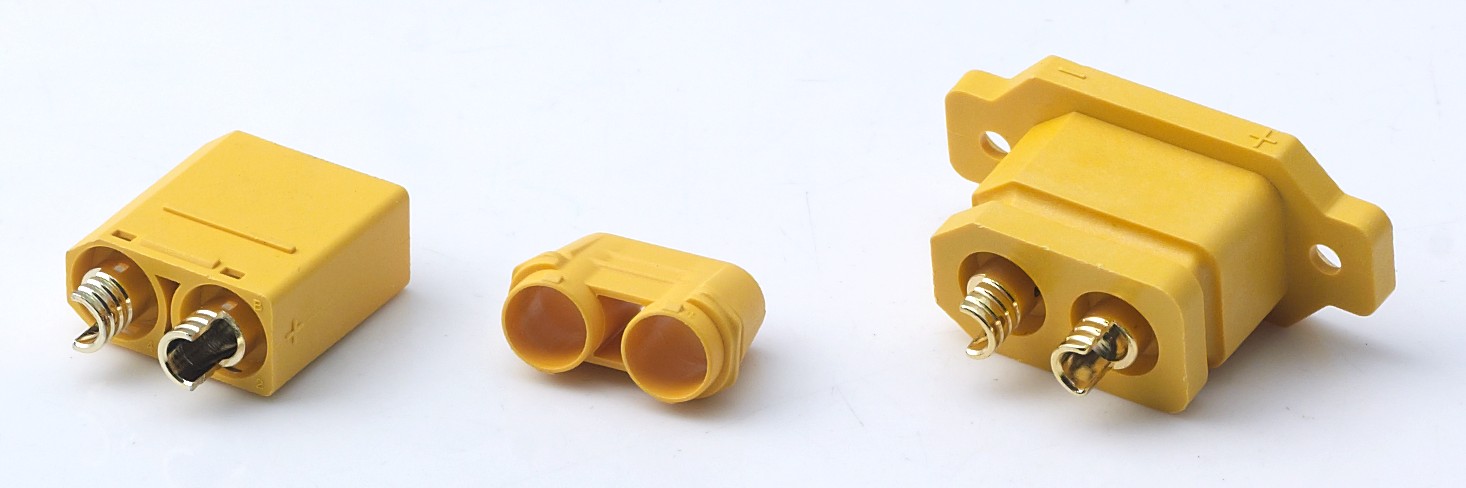
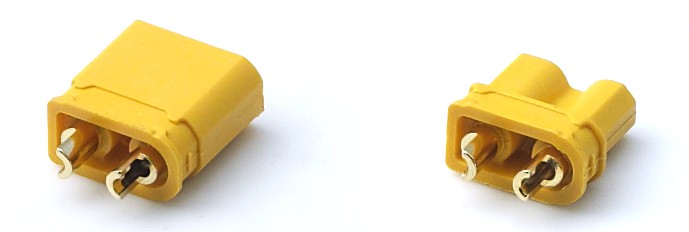
Cover: DXT90H-M+DXT90E-F Yellow, an IP40 high-current connector used for RC model electric vehicles and small UAV lithium battery packs.
The IP40 versus IP67 decision is not a question of which rating sounds safer. It is a question of which protection level matches the environment where the connection point actually lives — and of paying for sealing only where water, mud and dust can realistically reach the terminals.
Short answer: IP40 high-current connectors are the right default for indoor, enclosed and fair-weather builds, where the mating interface stays dry and mainly faces dust, vibration and repeated mating. IP67 connectors are for connection points exposed to rain, spray, splash, mud and long-term humidity — waterborne unmanned equipment, marine lithium battery systems, outdoor mobile photovoltaic energy storage, outdoor communication backup power, outdoor garden machinery and outdoor electric amusement equipment all fall into this group.
AOYG DC Power Connector supplies both protection levels inside one high-current connector portfolio, so the comparison below is built from published model data rather than from category assumptions. The goal is practical: match protection level to the real exposure of a UAV, RC or energy storage project instead of over- or under-specifying it.
What the IP40 vs IP67 Choice Actually Changes
An IP code carries two digits. The first describes protection against solid objects and the second describes protection against water. In an IP40 connector, the housing protects the live interface against solid objects but provides no water protection at all. In an IP67 connector, the enclosure is dust-tight and the interface is sealed against the effects of temporary immersion in water. Those two digits are the whole difference between a connector that can be used on an open deck and one that should stay inside a dry bay.
On a high-current DC connector, water protection is created by a sealing system rather than by a thicker wall. The IP67 DXT60EW-M+DXT60W-F uses a silicone O-ring inside a sealed housing, combined with gold-plated H62 brass terminals and a PA66 UL94 V-0 flame-retardant nylon body. The IP40 versions rely on terminal geometry and housing material alone — for example PA66 UL94 V-0 housings and gold-plated brass terminals — without a sealing element, because there is no water path to block in their intended installation.
Under-specifying protection creates two predictable failure paths. First, moisture and fine dust reach the contact surface and accelerate corrosion of the plating; contact resistance then rises, the joint runs hotter at the same current, and the connection becomes intermittent. Second, contamination inside the interface interferes with the mating geometry itself, so a connector that behaved perfectly in a dry workshop becomes unreliable after a season of rain, mud or salt air.
Over-specifying has its own cost. Sealing only works while the sealing element is intact — an O-ring that is pinched, missing or contaminated during field assembly no longer delivers IP67 behaviour, which means a sealed connector has to be specified together with an assembly and service routine, not simply added to a bill of materials. There is also a functional point that is easy to miss: protection grade describes ingress protection only, not every function of the connector. The IP67 DXT60EW-M+DXT60W-F does not have an anti-spark structure, so live plugging and unplugging of large-capacity batteries is not recommended. The IP40 DXT90H-M/DXT90S-F, by contrast, pairs a reinforced male with an anti-spark female that contains a built-in pre-charge resistor and a two-stage contact design to suppress the arc when a LiPo pack is connected.
Decision rule: choose the protection level from the exposure pathway of the mating interface, not from the general product category. "Drone" does not automatically mean IP67. A connector inside a sealed battery bay on a fair-weather RC aircraft does not need it; an inspection robot working in rain does.
Industry Background: Why Protection Level Sits Higher on the Specification Sheet
High-current DC connection is a growing slice of a large connector market. The global high power connectors market was valued at approximately USD 5.47 billion in 2025, according to Fact.MR. Within energy storage applications, DC connectors represented 58.7% of the market in 2025, a share that Dataintelo attributes to higher voltage requirements in storage systems. Both data points point in the same direction: more power is being moved through DC interfaces, and more of those interfaces are being asked to work outside a clean cabinet.
Outdoor infrastructure reinforces the same shift. 5G base stations consume 2–3 times more power than their 4G predecessors, with typical draws of 11.5 to 14 kW and peaks reaching 19 kW, which increases the current a backup power interface must carry reliably at the same time as the enclosure is exposed to weather.
On the interface side, XT60 and XT90 connectors remain the primary industry standards for medium to high power non-proprietary RC aircraft and drones in 2026, as noted in ChinaHobbyLine's RC battery connector compatibility guide. Because so much of the RC and UAV fleet is built around those footprints, buyers are far more likely to change the protection level of an interface they already use than to change its geometry. That is precisely the space in which IP40 standard versions and IP67 sealed versions of the same connector family compete.
Two demands are therefore growing in parallel. Outdoor equipment — waterborne unmanned platforms, mobile photovoltaic storage, outdoor charging and outdoor machinery — pushes part of the market toward sealed IP67 connections. At the same time, high-volume indoor and fair-weather applications continue to be built with IP40 connectors, because unsealed connectors are simpler to assemble, easier to inspect and entirely adequate in a dry environment.
The AOYG High-Current DC Power Connector Range: IP40 Standard and IP67 Sealed
AOYG DC Power Connector is a manufacturer and solution provider specialising in high-current DC connection systems for lithium-ion smart devices, covering commercial and industrial drones, intelligent service robots, garden power tools and portable cleaning equipment. The company runs a 6,000 m² production facility with 100 employees and a 25-engineer R&D team, holds IATF 16949:2016 automotive quality management system certification, and exports to Europe, America and Southeast Asia, with the EU and USA as its main markets.
Two protection levels are offered in the same portfolio. The IP67 option is a dedicated sealed design; the IP40 options are standard high-current connectors covering different current classes and pin configurations. Both families follow the same material logic — gold-plated brass terminals, PA66 UL94 V-0 flame-retardant housings and an operating temperature range of -20°C to +120°C.
IP67 Sealed Option: DXT60EW-M+DXT60W-F Waterproof High Current Connector
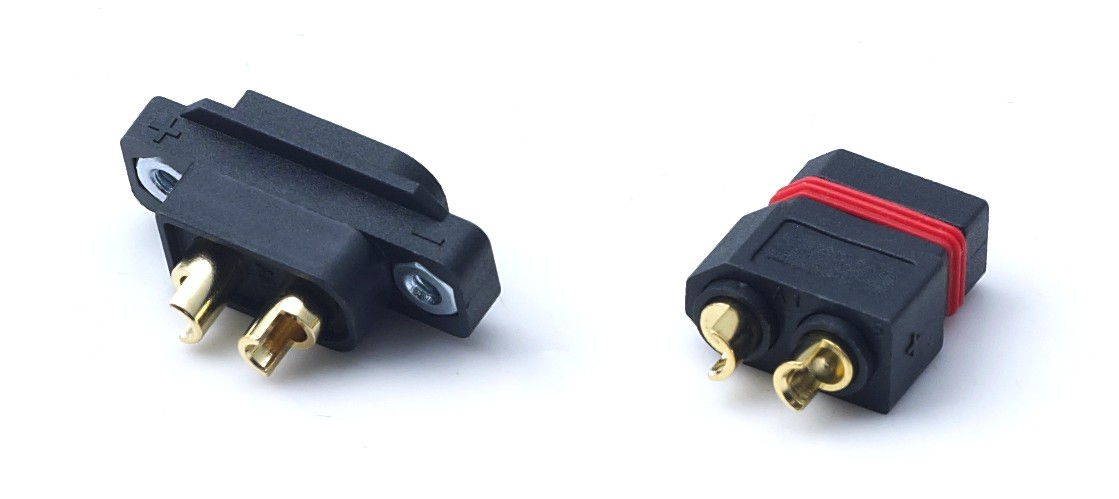
DXT60EW-M+DXT60W-F: the IP67 sealed option in the AOYG high-current connector range, rated 60A continuous and 100A peak.
- Protection grade: IP67, sealed with a silicone O-ring
- Rated voltage: DC 500V
- Continuous current: 60A; peak current: 100A
- Terminal: Φ5mm H62 brass, gold-plated; beryllium copper gold-plated spring contact
- Contact resistance: ≤0.8mΩ
- Operating temperature: -20°C to +120°C
- Mating cycles: ≥1000
- Housing: PA66 UL94 V-0 flame-retardant nylon
- Applicable wire: 8–10AWG silicone wire
- Supply formats: separate male plug (DXT60EW-M), separate female plug (DXT60W-F), mated pair, or pre-wired harness with custom cable length
Its intended applications are waterborne unmanned equipment, outdoor mobile photovoltaic energy storage, marine lithium battery systems, outdoor communication backup power, outdoor garden machinery, outdoor 5G base station standby power and outdoor electric amusement equipment. One limitation is stated openly by the manufacturer: this model does not have an anti-spark structure, so live plugging and unplugging of large-capacity batteries is not recommended.
IP40 Standard Options: Four High-Current Families
DXT90H-M/DXT90S-F UAV connector (IP40, 90A class). Rated DC 500V with 90A continuous operating current on 10AWG wire (temperature rise ≤85°C) and 120A peak capability. The mated set pairs a reinforced bare male with an anti-spark bare female whose built-in pre-charge resistor and two-stage contact design suppress the arc when a LiPo battery is connected. It uses a 4.5mm gold-plated banana plug, withstands AC 2000V for one minute, carries a UL94 V-0 rating, operates from -20°C to +120°C, is rated for at least 1000 mating cycles, and passes a 48-hour salt spray test on the gold-plated standard model. It is dimensionally compatible with regular XT90 connectors for straightforward upgrades, and is supplied as a bare connector or as a silicone cable assembly in 8AWG/10AWG with customizable wire length.
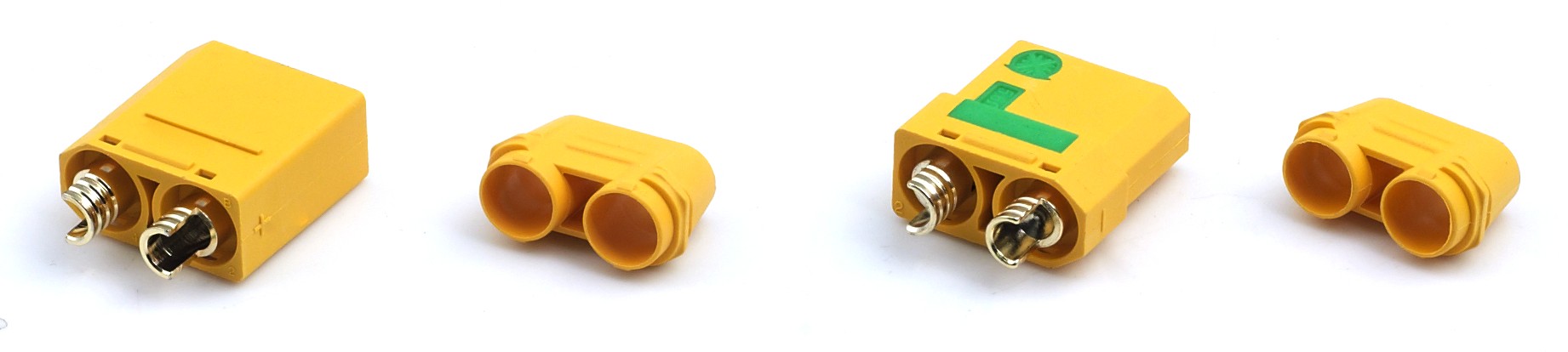
DXT90H-M/DXT90S-F: an IP40 90A-class UAV connector set with a built-in anti-spark female for LiPo battery connection.
DXT90H-M+DXT90E-F Yellow RC model electric vehicle connector (IP40, 45A class). Rated DC 500V with 45A continuous current on 10AWG wire (temperature rise below 85°C) and a 90A short-term peak. It uses a Φ4.5mm gold-plated brass banana terminal, ≤1.0mΩ contact resistance, ≥2000MΩ insulation resistance, AC 2000V/1min withstand voltage and a UL94 V-0 PA66 nylon housing, with the same -20°C to +120°C operating range and ≥1000 mating cycles. The bright yellow housing helps circuit identification, and anti-misplug keying prevents reverse-polarity connection. It is widely used for RC cars, RC boats, aircraft models and small UAV lithium batteries.
DXT30U(2+2)-F(B) female connector (IP40, 2+2 power-signal combo). This is the composite option: two power pins plus two signal pins in a single housing, so power and sensing signals cross one interface instead of two separate harnesses. The power pin is rated 20A continuous on 16AWG wire, with a 1A signal pin and a 35A peak; contact resistance is ≤1.2mΩ and insulation resistance ≥2000MΩ. It is rated DC 500V, IP40, PA66 UL94 V-0, -20°C to +120°C, at least 1000 mating cycles, with a 48-hour salt spray test and RoHS 2.0 / REACH SVHC compliance. It mates with the DXT30U(2+2)-M cable-soldered counterpart and with vertical-mount PB and horizontal-mount PW PCB male headers, and accepts 12–16AWG silicone wire.
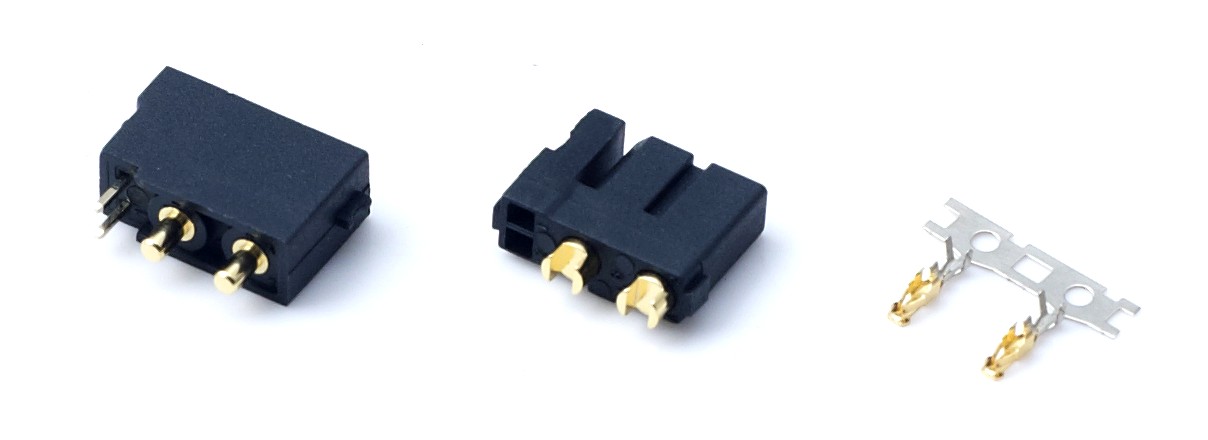
DXT30U(2+2) series: a 2+2 power-signal composite interface that carries high current and sensing signals in one housing.
DXT30U-M/DXT30U-F drone connector (IP40, 15A class). The lightweight end of the range: DC 500V, 15A continuous with a 30A short-term peak, Φ2mm gold-plated banana terminals, ≤0.7mΩ contact resistance, ≥2000MΩ insulation resistance and AC 2000V/1min withstand voltage. The optimized buckle allows bidirectional blind mating and stays locked under drone vibration. Recommended wire is 18AWG silicone, compatible with 20AWG. It targets tiny FPV drones, small UAVs, RC models, portable lithium battery packs, lightweight electric mobility and educational robots.
DXT30U-M/DXT30U-F Yellow: a compact IP40 connector for weight-sensitive FPV and small UAV builds.
Step-by-Step: Matching Protection Level to Your Project
Step 1 — Map the exposure of the mating interface. Write down what the connection point actually sees in service: rain, splash, wash-down, mud, salt air, condensation from temperature cycling, or only indoor dust. A device-level enclosure rating does not protect the connector; only what reaches the interface does.
Step 2 — Decide whether the interface is on the splash path. A battery connector inside a sealed bay, behind a cover, or on a fair-weather RC model is not on the splash path, and an IP40 connector is normally sufficient. An open-deck connector on waterborne equipment, an exposed harness on outdoor stored equipment, or any connection point that sees direct rain is on the splash path and should be specified at IP67.
Step 3 — Fix the current class before the protection class. Protection level does not set current capacity; the terminal and housing do. Determine continuous and peak current first, then choose the class: 15A continuous with 30A peak (DXT30U-M/DXT30U-F), 20A power pin with 1A signal and 35A peak (DXT30U(2+2)-F(B)), 45A continuous with 90A peak (DXT90H-M+DXT90E-F Yellow), 90A continuous with 120A peak (DXT90H-M/DXT90S-F), or 60A continuous with 100A peak (DXT60EW-M+DXT60W-F).
Step 4 — Pair the connector with the specified wire gauge. The published specification defines the conductor: 18AWG silicone (compatible with 20AWG) for the 15A drone connector, 12–16AWG for the 2+2 combo, 10AWG with 8AWG compatibility for the 45A RC and 90A UAV connectors, and 8–10AWG silicone wire for the 60A IP67 connector. Using a smaller conductor than specified is a common cause of overheating that has nothing to do with the connector rating itself.
Step 5 — Check temperature range and mating life together. Every model in this range operates from -20°C to +120°C and is rated for at least 1000 mating cycles. Mating life matters most in battery-swap applications — battery exchange cabinets, modular storage systems, and RC or UAV fleets where packs are changed many times per week.
Step 6 — Decide whether signal pins belong in the same housing. If the battery pack also needs a sensing or communication line, the 2+2 power-signal composite design reduces harness count and saves internal space compared with running separate power and signal connectors through the same enclosure.
Step 7 — Confirm compliance and sealing materials, then validate with a sample. Check the certification set that applies to the destination market, confirm the housing and sealing materials in the datasheet, and validate the assembly in a sample build before mass production. AOYG supports sample testing, and 100% of production units are tested.
Use Cases: Where IP40 Is Enough and Where IP67 Is Required
- Tiny FPV drones and small RC models (IP40): DXT30U-M/DXT30U-F, 15A continuous and 30A peak in a compact, lightweight body for weight-sensitive builds.
- RC cars, boats and aircraft models (IP40): DXT90H-M+DXT90E-F Yellow, 45A continuous and 90A peak, with anti-misplug keying and a 48-hour salt-spray-tested gold-plated terminal.
- Multi-rotor and agricultural UAVs (IP40 with anti-spark): DXT90H-M/DXT90S-F, 90A continuous and 120A peak, where the anti-spark female suppresses arcs during battery connection — a more frequent risk in high-current drone packs than water ingress.
- Waterborne unmanned equipment and marine lithium battery systems (IP67): DXT60EW-M+DXT60W-F, sealed with a silicone O-ring for dust and water protection.
- Outdoor mobile photovoltaic storage and outdoor 5G base station standby power (IP67): the same sealed 60A/100A connector, where equipment is exposed to humidity and rain over long service periods.
- Outdoor garden machinery and outdoor electric amusement equipment (IP67): exposure to wash-down, mud and weather rather than to a controlled indoor bay.
- Service robots, garden power tools, smart device battery packs and BMS assemblies (IP40): the 2+2 composite connector, where space is limited and both power and signal must cross a single interface.
IP40 vs IP67 High-Current Connector Comparison (AOYG Models)
| Specification | IP40 standard options | IP67 sealed option |
|---|---|---|
| Model examples | DXT90H-M/DXT90S-F (UAV); DXT90H-M+DXT90E-F Yellow (RC); DXT30U(2+2)-F(B) (2+2 power-signal); DXT30U-M/DXT30U-F (drone) | DXT60EW-M+DXT60W-F (DXT60EW-M male plug + DXT60W-F female plug) |
| Protection grade | IP40; no water protection | IP67; silicone O-ring sealing |
| Rated voltage | DC 500V | DC 500V |
| Continuous current | 90A (DXT90H-M/DXT90S-F); 45A (DXT90H-M+DXT90E-F Yellow); 20A power pin and 1A signal pin (DXT30U(2+2)-F(B)); 15A (DXT30U-M/DXT30U-F) | 60A |
| Peak current | 120A (UAV); 90A short-term (RC); 35A (2+2); 30A short-term (drone) | 100A |
| Contact resistance | ≤1.0mΩ (RC); ≤1.2mΩ (2+2); ≤0.7mΩ (drone) | ≤0.8mΩ |
| Terminal | Φ4.5mm and Φ2mm gold-plated brass banana terminals | Φ5mm H62 brass, gold-plated, with beryllium copper gold-plated spring contact |
| Housing material | PA66 UL94 V-0 | PA66 UL94 V-0 flame-retardant nylon |
| Operating temperature | -20°C to +120°C | -20°C to +120°C |
| Mating cycles | ≥1000 | ≥1000 |
| Applicable wire | 18AWG silicone, compatible with 20AWG (drone); 12–16AWG (2+2); 10AWG, compatible with 8AWG (RC and UAV) | 8–10AWG silicone wire |
| Anti-spark feature | Available on the DXT90S-F anti-spark female, which has a built-in pre-charge resistor and two-stage contact design | Not available; live plugging and unplugging of large-capacity batteries is not recommended |
| Typical environment | Indoor equipment, enclosed battery bays, fair-weather RC and UAV builds, dry dust exposure | Rain, spray, mud, long-term humidity, marine conditions and temporary immersion exposure |
FAQ: IP40, IP67 and High-Current Connector Selection
Which certifications cover AOYG high-current DC power connectors for export markets?
The certification set covers both protection levels. The Waterproof High Current Connector DXT60EW-M+DXT60W-F, the DXT30U(2+2)-F(B) female connector, the RC model electric vehicle connector and the UAV connector are covered by an ISO 9001:2015 certificate issued by a CNCA-accredited certification body, and by a CE-LVD Declaration of Conformity based on Directive 2014/35/EU (LVD) and EN 61984. All of these connectors are also covered by REACH SVHC testing to Regulation (EC) No 1907/2006 and the ECHA SVHC Candidate List, and by RoHS 2.0 testing to the IEC 62321 series. Salt spray testing to GB/T 10125 and ASTM B117 (Neutral Salt Spray) covers the DXT60EW-M+DXT60W-F, the DXT30U(2+2)-F(B), the DXT90H-M+DXT90E-F Yellow, the DXT90H-M/DXT90S-F and the DXT30U-M/DXT30U-F. Housing materials are classified UL94 V-0 under UL 94, and the UAV connector is additionally covered by an electrical performance test report based on IEC 60512 and GB/T 5095. At factory level, AOYG holds IATF 16949:2016 automotive quality management system certification.
Can the same high-current connector be supplied in both IP40 and IP67 versions?
Not as a single convertible part. The two protection levels are separate designs: the IP67 rating of the DXT60EW-M+DXT60W-F comes from a dedicated sealed housing with a silicone O-ring, whereas the IP40 models — DXT90H-M/DXT90S-F, DXT90H-M+DXT90E-F Yellow, DXT30U(2+2)-F(B) and DXT30U-M/DXT30U-F — rely on housing and terminal geometry without a sealing system. Choosing between them is therefore a choice between two models, not between an accessory and a base part. Both levels are supplied as bare connectors, mated pairs, or pre-wired harnesses with custom cable length where applicable, and the 2+2 model mates with cable-soldered, vertical-mount PB and horizontal-mount PW PCB male headers.
What determines the cost level of an IP40 versus an IP67 connector?
Cost in this category follows materials, sealing and testing rather than the protection-grade label itself. The IP67 model adds a silicone O-ring sealing system, while both levels use gold-plated brass terminals and PA66 UL94 V-0 flame-retardant housings. Both are produced under an IATF 16949:2016 quality system with 100% product testing, and both carry the same certification families — ISO 9001:2015, CE-LVD, RoHS 2.0, REACH SVHC and UL94 V-0. Buyers comparing quotations should therefore compare the full specification, including terminal plating, sealing element, wire gauge compatibility, mating-cycle rating and certification coverage, rather than a single unit price. Because over-specifying protection also adds assembly discipline a project may not need, matching level to environment is itself a cost decision.
Can I test samples before committing to mass production?
Yes. AOYG supports sample testing and offers a minimum order quantity of 2 units, together with professional OEM and ODM services covering customized size, current specification, pin position, wiring structure and logo printing. Samples can be developed against the customer's drawings, samples and technical parameters, so the protection level, wire gauge and pin configuration can be validated on the actual battery or equipment interface before a production order is placed.
What is the typical lead time, and how do I start a high-current connector project?
Standard lead time is 30–45 days, and 100% of production units are tested before shipment; products are exported to Europe, America and Southeast Asia, with remote after-sales technical support. To start, share the application environment (dry bay, splash exposure, or continuous outdoor humidity), the continuous and peak current, the wire gauge, and whether signal pins are required. The technical team can then confirm whether an IP40 model such as DXT90H-M/DXT90S-F or an IP67 model such as DXT60EW-M+DXT60W-F fits the build, and provide a sample for validation. Requests can be sent through www.aoygvn.com.
Conclusion: Match the Protection Level, Not the Marketing Label
IP40 and IP67 are not competing quality tiers in the AOYG high-current connector range; they are two answers to two different environments. IP40 remains the efficient default for indoor, enclosed, fair-weather and dry-dust applications across FPV drones, RC models, service robots, garden power tools and portable lithium battery packs. IP67 earns its place wherever the mating interface meets rain, spray, mud, salt air or sustained humidity — waterborne unmanned equipment, marine lithium battery systems, outdoor mobile photovoltaic storage, outdoor communication backup power, outdoor garden machinery and outdoor 5G standby power.
The practical method stays the same in every project: map the exposure of the interface, decide whether it sits on the splash path, fix the current class and wire gauge, confirm the temperature range and mating-cycle requirement, check whether signal pins must share the housing, and verify the certification set and sealing materials against the destination market. Where a project genuinely needs water protection, specify the sealed IP67 model; where it does not, keep the simpler IP40 model and invest the difference in current headroom and harness quality.

AOYG DC Power Connector supplies both IP40 and IP67 high-current connector options for UAV, RC, robot and energy storage projects.
Still deciding between IP40 and IP67? Send your application environment, current requirement and wire gauge to the AOYG team through www.aoygvn.com and request a sample from the IP40 or IP67 series — minimum order quantity is 2 units, sample testing is supported, and standard lead time is 30–45 days.
Have Questions or Need More Details?
Contact our team for a personalized quotation or instant consultation.
Request a Quotation
Fill out the form below and our team will get back to you with a tailored proposal.
WhatsApp Direct Chat
Prefer to chat in real-time? Message us on WhatsApp for instant assistance & quick answers.
- Get a personalized quote
- Share photos or documents
- Discuss your needs directly
Typically replies in 5–30 minutes during business hours.