How to Match Current, Voltage and Temperature Ratings in High-Current DC Connectors
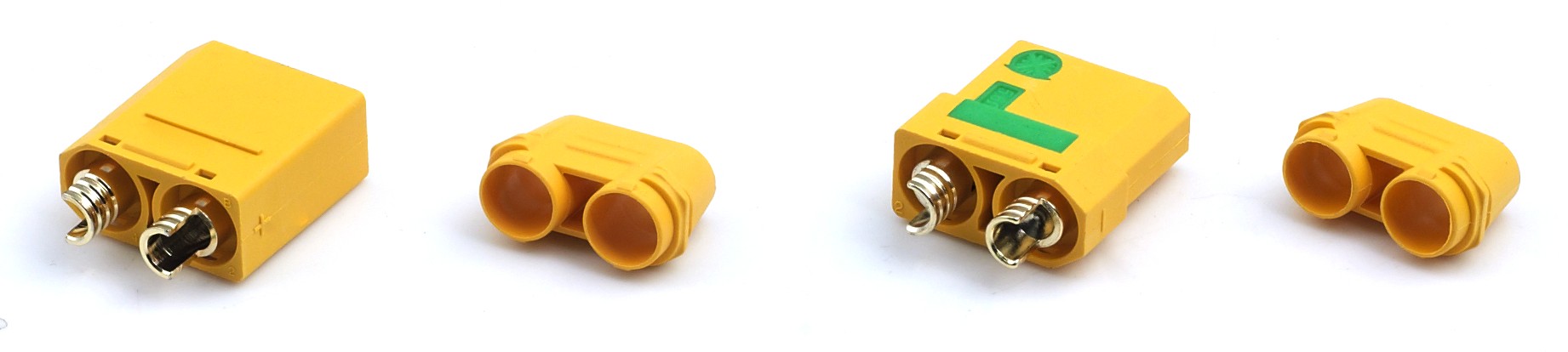
A high-current DC power connector is matched correctly only when three ratings — continuous current, rated voltage and operating temperature — are read together against the same wire gauge and the same ambient conditions. The '90A' printed in a datasheet is not a stand-alone capability; it is the current a connector can carry continuously under a defined conductor size and a defined temperature-rise limit. Change the wire, the ambient temperature or the contact interface, and the usable current changes with it.
AOYG DC Power Connector (www.aoygvn.com) is a manufacturer and solution provider specializing in high-current DC connection systems for lithium-ion smart devices. The company operates a 6,000 m² production facility with 100 employees, a 25-engineer R&D team and an annual output of 900,000 units, exporting approximately 50% of production to EU and USA markets under an IATF16949:2016 automotive quality management system. Its DXT-series connectors cover continuous currents from 15A to 90A at a DC 500V rating.
This guide covers three things: how the three ratings should be read together, how contact resistance and gold-plated terminals determine low-loss performance, and how the matching logic shifts across UAV, battery swap and chemically exposed industrial environments.
What Rating Matching Actually Means
Rating matching is a compatibility check between four variables, only one of which the connector controls by itself: the load current profile, the conductor cross-section, the ambient temperature, and the acceptable heat generation at the contact interface.
In practice, most mismatches are not wrong products. They are correct products used outside the conditions under which their ratings were established.
- Current mismatch. A connector rated 45A continuous with 10AWG wire carries a load that was calculated at a higher value, or is assembled with a thinner conductor than the rating assumes.
- Voltage mismatch. A DC 500V part is used in a circuit whose transient behaviour was never compared against the connector's dielectric withstand test.
- Temperature mismatch. The temperature rise allowed at rated current is added to an ambient that already sits near the top of the -20°C to +120°C window.
- Contact mismatch. Terminals with unverified contact resistance and plating are used in a high-vibration, high-humidity duty cycle where the plating — not the housing — decides long-term loss.
The hidden variable: contact resistance
Contact resistance is the part of a connector rating that buyers most often skip. It is also the part that converts electrical performance into thermal performance: heat generated at the contact interface adds directly to the connector's temperature rise. In the AOYG DXT range, published contact resistance values run from ≤0.7 mΩ (DXT30U-M / DXT30U-F) through ≤0.8 mΩ (DXT60EW-M + DXT60W-F) and ≤1.0 mΩ (DXT90H-M + DXT90E-F Yellow) to ≤1.2 mΩ (DXT30U(2+2)-F(B)).
Those figures are what make a current rating meaningful. A 90A continuous rating is realistic only when the terminal interface, the crimp or solder joint and the wire sleeve are all sized to the same current.
Industry Background: Why Rating Discipline Matters More Than It Used To
Three structural changes have pushed low-voltage DC current ratings into the centre of connector selection.
First, the market itself is large. Fact.MR valued the global high power connectors market at approximately USD 5.47 billion in 2025, covering connectors engineered specifically for high power and high current transmission.
Second, DC is taking share where AC once dominated. Dataintelo reported that DC connectors represented 58.7% of the energy storage connector market in 2025, attributing the shift to higher voltage requirements in storage systems. Higher DC bus voltages move design attention — and responsibility — toward rated voltage, insulation resistance and dielectric withstand, not only current.
Third, backup power loads per site keep rising. Industry planning guidance for telecom sites indicates that 5G base stations consume two to three times the power of their 4G predecessors, typically drawing 11.5–14 kW and peaking at 19 kW. At the backup connection point, that translates into sustained current through a low-voltage DC connector — the reason outdoor 5G base station standby power is listed as an application for a sealed, high-current part such as the IP67-rated DXT60EW-M + DXT60W-F.
A fourth, quieter change is standardisation. In 2026, XT60 and XT90 remain the primary industry standards for medium-to-high power non-proprietary RC aircraft and drone connections. That means buyers evaluating an AOYG high-current DC power connector usually compare it against an established form factor, and need ratings stated in comparable terms.
The AOYG Rating Set: What Each Number Is Based On
Reading a rating correctly means reading its conditions. The DXT-series entries below show how current, voltage, temperature and contact data are published together.
90A continuous — DXT90H-M / DXT90S-F (UAV connector)
Rated voltage is DC 500V, and continuous operating current is 90A with 10AWG wire at a temperature rise of ≤85°C. The terminal is a 4.5 mm banana plug; dielectric strength is verified by an AC 2000V / 1min withstand test; the housing is PA66 high-temperature nylon rated UL94 V-0 with an IP40 protection level; operating temperature is -20°C to +120°C; mating life is ≥1000 insertions; the gold-plated standard model is tested for 48 hours of salt spray. The recommended conductor is 10AWG flexible cable, compatible with 8AWG. Surface treatment is gold plating at a standard 0.3 µm, with thicker industrial gold plating available. The DXT90S-F female side carries a built-in high-power precharge resistor.
60A continuous / 100A peak — DXT60EW-M + DXT60W-F (waterproof high current connector)
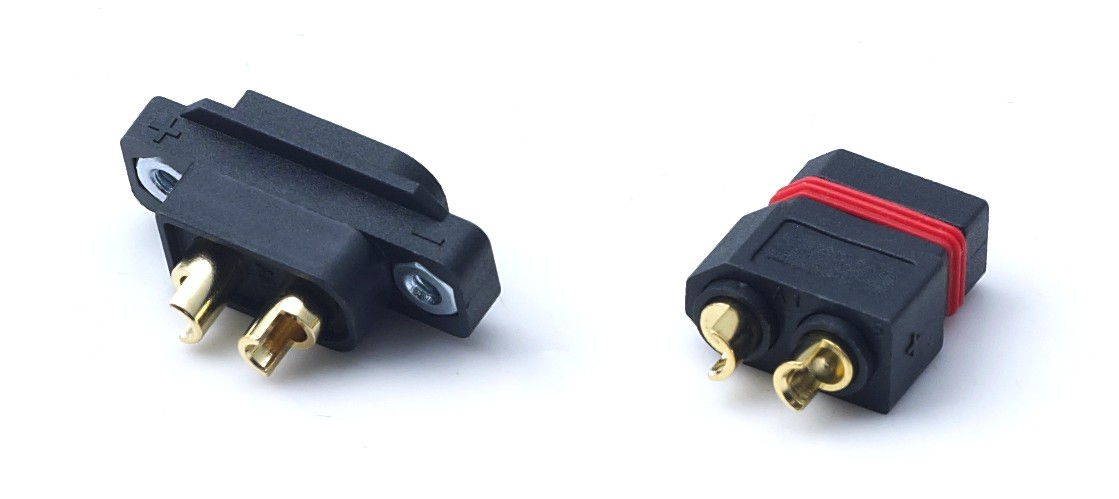
This model combines the highest continuous rating in the range with full sealing. Rated voltage is DC 500V; continuous current is 60A with a 100A peak; contact resistance is ≤0.8 mΩ — the lowest published in the DXT range; the terminal is a Φ5 mm H62 brass gold-plated pin and the contact spring is beryllium copper, also gold-plated. Silicone O-ring sealing gives IP67 protection, and operating temperature remains -20°C to +120°C across ≥1000 mating cycles with 8–10AWG silicone wire.
45A continuous / 90A peak — DXT90H-M + DXT90E-F Yellow (RC model electric vehicle connector)
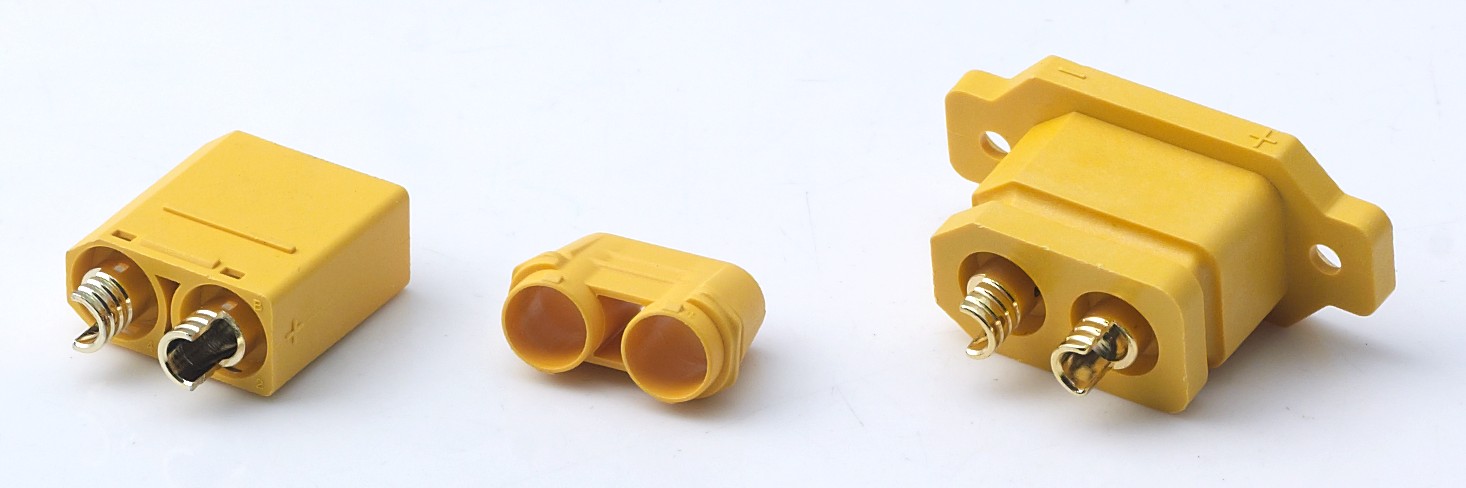
Rated voltage is DC 500V, continuous current 45A with 10AWG wire at a temperature rise below 85°C, and short-term peak current 90A — the clearest example in the range of why continuous and peak ratings must be matched separately. Contact resistance is ≤1.0 mΩ, insulation resistance ≥2000 MΩ, withstand voltage AC 2000V / 1min, and the pairing runs ≥1000 mating cycles with a 48-hour salt spray test on the gold-plated terminal. The 10AWG recommendation is compatible with 8AWG, and the housing is a yellow flame-retardant PA66 Nylon rated UL94 V-0.
20A power + 1A signal — DXT30U(2+2)-F(B) (power–signal composite)
This is a 2+2 configuration: two power pins rated 20A each with 16AWG wire, plus two signal pins rated 1A. Peak current is 35A, rated voltage DC 500V, contact resistance ≤1.2 mΩ, insulation resistance ≥2000 MΩ, protection class IP40, operating temperature -20°C to +120°C, and ≥1000 mating cycles. The applicable wire range is 12–16AWG silicone wire, the terminal is H62 brass, gold-plated, and the housing is black PA66 UL94 V-0.
15A continuous / 30A peak — DXT30U-M / DXT30U-F (drone connector)
At the low end of the high-current range, the DXT30U-M / DXT30U-F is rated 15A continuous with a 30A short-term peak at DC 500V, with a Φ2 mm gold-plated banana terminal, ≤0.7 mΩ contact resistance, ≥2000 MΩ insulation resistance, IP40 protection and an 18AWG recommendation compatible with 20AWG.
Evaluating contact resistance and gold-plated terminals
Two published details do most of the work in low-loss performance.
Contact resistance values set the floor for heat generation at the interface. Lower values matter most where current is highest and cooling is weakest: a sealed IP67 assembly trades ventilation for protection, which makes the ≤0.8 mΩ interface on the DXT60EW-M + DXT60W-F more significant than the same figure would be in an open IP40 part.
Plating thickness and material stack set the durability of that low-resistance interface. AOYG uses gold plating at a standard 0.3 µm on H62 brass terminals, with thicker industrial gold plating available as an option, plus a gold-plated beryllium copper contact spring. Corrosion performance is stated as a 48-hour salt spray test on gold-plated terminals, measured against GB/T 10125 and ASTM B117 (neutral salt spray) by a third-party laboratory with CNAS, CMA and ISO17025 accreditation.
Practical limit to note: gold plating controls corrosion and stabilises the interface, but it does not raise a connector's current rating. A 45A connector with premium plating is still a 45A connector. The correct response to a higher load is a larger terminal, a larger conductor or a higher-rated model — not a thicker coating.
Step-by-Step: Matching a Connector to a Real Load
Step 1 — Write down the load profile, not just the maximum current
Separate continuous current from short-term peak current. The DXT90H-M + DXT90E-F Yellow is rated 45A continuous and 90A short-term peak; the DXT60EW-M + DXT60W-F is 60A continuous and 100A peak. Size the continuous figure against normal operation and confirm the peak figure covers the inrush or acceleration event.
Step 2 — Match the continuous current to the recommended wire gauge
The rating and the conductor are a pair: 90A with 10AWG; 60A with 8–10AWG; 45A with 10AWG; 20A per power pin with 16AWG; 15A with 18AWG. If the project requires 8AWG for other reasons, the 90A and 45A models are documented as compatible with it.
Step 3 — Confirm voltage headroom
All models in the range are rated DC 500V, with insulation resistance ≥2000 MΩ and an AC 2000V / 1min withstand voltage test. Rated voltage should be checked against the highest transient the circuit can produce, not only the nominal bus voltage.
Step 4 — Build the temperature budget
The operating window is -20°C to +120°C, and the rating conditions specify a temperature rise (≤85°C for the 90A model; below 85°C for the 45A model at 10AWG). Ambient temperature plus that rise must stay inside the window, and the housing — PA66 rated UL94 V-0 — is what keeps the assembly dimensionally stable as it heats.
Step 5 — Fix the contact resistance and plating target
Choose the model whose published contact resistance sits comfortably below the loss you can accept, then confirm plating: standard 0.3 µm gold plating, or thicker industrial gold plating where corrosion exposure is higher.
Step 6 — Match sealing and mechanical life to the environment
IP40 for protected, dry or indoor assemblies; IP67 with silicone O-ring sealing where rain, splash, humidity or washdown is present. Mating life is ≥1000 cycles across the range, which supports battery-swap duty. Where high inrush current is present, an anti-spark precharge resistor version — as built into the DXT90S-F — reduces arc damage at mating.
Step 7 — Validate with samples before committing to volume
Rating matching is confirmed by test, not by calculation alone. Sample testing, model-selection guidance and assembly-solution review are part of the supplier's service scope, and OEM/ODM customization can adjust size, current specification, pin position and wiring structure when a standard model does not fit.
Rating Comparison Table
| Model | Rated voltage | Continuous current | Peak / transient | Contact resistance | Protection | Recommended wire | Typical application |
|---|---|---|---|---|---|---|---|
| DXT90H-M / DXT90S-F | DC 500V | 90A (10AWG, temp rise ≤85°C) | — | — | IP40 | 10AWG, compatible with 8AWG | Agricultural drone, multi-rotor UAV, LiPo battery power connection |
| DXT60EW-M + DXT60W-F | DC 500V | 60A | 100A | ≤0.8 mΩ | IP67 | 8–10AWG silicone wire | Waterborne unmanned equipment, outdoor mobile photovoltaic storage, marine lithium battery systems, outdoor 5G base station standby power, outdoor garden machinery |
| DXT90H-M + DXT90E-F Yellow | DC 500V | 45A (10AWG, temp rise <85°C) | 90A short-term | ≤1.0 mΩ | IP40 | 10AWG, compatible with 8AWG | RC cars, RC boats, aircraft models, small UAV lithium batteries |
| DXT30U(2+2)-F(B) | DC 500V | 20A per power pin (16AWG); 1A per signal pin | 35A | ≤1.2 mΩ | IP40 | 12–16AWG silicone wire | UAV, FPV drone, RC hobby models, light-duty e-bike, portable energy storage, robot, garden power tools, BMS |
| DXT30U-M / DXT30U-F | DC 500V | 15A | 30A short-term | ≤0.7 mΩ | IP40 | 18AWG, compatible with 20AWG | Small FPV drones, small UAVs, RC models, portable lithium battery packs, lightweight e-mobility, educational robots |
Every model listed uses a PA66 UL94 V-0 flame-retardant housing, operates from -20°C to +120°C, is rated for ≥1000 mating cycles and, in gold-plated form, is tested for 48 hours of neutral salt spray. A dash marks a value that is not published in the product data used for this comparison.
Use Cases: Where the Matching Logic Changes
Agricultural and multi-rotor UAV power
UAV duty cycles combine continuous high-current discharge with continuous flight vibration and frequent battery swapping. The priority order here is continuous current first (90A with 10AWG at ≤85°C rise), mass second, and plating third, because a 48-hour salt spray qualification on gold-plated terminals covers dust, humidity and, on agricultural platforms, exposure to pesticide liquid.
Battery swap cabinets and electric two-wheelers
Battery exchange cabinets are a mechanical-life problem as much as an electrical one. The ≥1000 mating cycle rating, anti-reverse insertion design and, where sealing is required, IP67 silicone O-ring construction matter more than raw current. For light-duty e-bikes and portable energy storage, the 20A-power / 1A-signal DXT30U(2+2)-F(B) carries power and control signals through one connection instead of two.
Chemically exposed and outdoor industrial equipment
In chemically aggressive or continuously wet installations — outdoor garden machinery, water operation equipment, marine lithium battery systems, construction machinery and equipment installed in or near chemical processing areas — the deciding ratings are corrosion resistance and sealing rather than peak current. The relevant specification is a gold-plated terminal qualified by a 48-hour neutral salt spray test, a PA66 UL94 V-0 housing, and IP67 protection where splash or chemical contact is possible. Where the enclosure is protected and dry, IP40 is sufficient and the simpler unsealed assembly is the better match.
Robots, tooling and power-plus-signal devices
Intelligent service robots, AGV handling robots, garden power tools and smart device battery packs typically need moderate current plus a signal path. A 2+2 composite connector keeps the current rating honest — 20A per power pin is a different rating from 20A spread across four pins — while giving the BMS or controller a dedicated 1A signal circuit.
Frequently Asked Questions
Which standards and certifications support these connector ratings?
Company systems and product testing are separate layers. At company level, AOYG DC Power Connector holds an ISO9001:2015 quality management system certificate and an IATF16949:2016 automotive quality management system certification covering the full production process. At product level, the DXT series is supported by an Electrical Performance Test Report to IEC 60512 and GB/T 5095, a UL94 V-0 flammability test report on the housing material, a salt spray test report to GB/T 10125 and ASTM B117, and a REACH SVHC test report. Market-access documentation includes a RoHS 2.0 test report to IEC 62321 and a CE-LVD Declaration of Conformity to Directive 2014/35/EU and EN 61984 for EU and EEA markets.
Can an OEM high-current DC power connector be produced for RC aircraft and UAV builds?
Yes. OEM and ODM production services are available, including customized size, current specification, pin position, wiring structure and logo printing, as well as development of exclusive connector products based on a customer's application scenario and technical parameters. For RC aircraft, the DXT90H-M + DXT90E-F Yellow pairs a 45A continuous rating with a 90A short-term peak in a 10AWG build, while the DXT90H-M / DXT90S-F covers 90A continuous where the airframe and battery pack allow 10AWG wiring. Customization is supported by a 25-engineer R&D team with a monthly capacity of 8,000 units.
What is the minimum order quantity, and what drives the cost?
The minimum order quantity is 2 units, with FOB or CIF delivery terms and a 30/70 payment structure. Cost is driven mainly by the specification choices that affect rating and durability rather than by the basic housing: plating thickness (standard 0.3 µm gold plating or thicker industrial gold plating), terminal and spring materials (H62 brass and gold-plated beryllium copper), the sealing structure (IP67 silicone O-ring versus IP40), optional anti-spark precharge components, and whether a pre-wired harness is supplied.
Can I validate the rating match with samples before production?
Sample validation is part of the standard service scope, alongside model-selection guidance, product adaptation analysis and assembly-solution suggestions, plus sample-machine debugging and optimization support. Acceptance is based on pre-shipment testing, and after-sales support is provided remotely. In one documented case covering drone, robot, e-mobility, energy storage and power tool manufacturers, connectors supplied on this basis have operated for two years with stable performance.
What is the production lead time once a specification is confirmed?
Lead time is 30–45 days after specification confirmation, against a monthly capacity of 8,000 units. Because rating matching is decided by wire gauge, plating and sealing options, the specification review is the step that determines how quickly a custom build can be scheduled — which is why sample testing before volume production shortens the overall project timeline rather than extending it.
Conclusion: Match Ratings as a Set, Not as a List
Current, voltage and temperature ratings are three views of the same thermal and dielectric problem, and they hold together only when the wire gauge, ambient conditions and contact interface are defined at the same time. Start from the load profile, tie the continuous current to the conductor size, confirm the voltage and withstand margins, build a temperature budget that includes the allowed temperature rise, then choose the contact resistance and plating level the environment justifies. Finally, validate the match with a sample before committing to a production schedule.
Next Step: Validate Your Rating Match

AOYG DC Power Connector supplies high-current DC connectors from 15A to 90A at DC 500V for UAV, drone, robot, battery swap, energy storage, garden tool and outdoor equipment projects. If you are evaluating a rating match, send your continuous current, peak current, working voltage, conductor size and ambient temperature — the technical team will return a model recommendation, a sample plan and an assembly suggestion.
Website: www.aoygvn.com | Email: xiuweizhao77@gmail.com | WhatsApp: +84 366770891
Have Questions or Need More Details?
Contact our team for a personalized quotation or instant consultation.
Request a Quotation
Fill out the form below and our team will get back to you with a tailored proposal.
WhatsApp Direct Chat
Prefer to chat in real-time? Message us on WhatsApp for instant assistance & quick answers.
- Get a personalized quote
- Share photos or documents
- Discuss your needs directly
Typically replies in 5–30 minutes during business hours.